Complete Unknown
A German philosopher most people don't know about

This is series is on the foundations and Founding Fathers of the United States. Follow this link to the first article in the series.
Samuel von Pufendorf (1632 –1694) was a German jurist, political philosopher, economist and historian. He was born Samuel Pufendorf and ennobled in 1694; he was made a baron by Charles XI of Sweden a few months before his death at age 62. Among his achievements are his commentaries and revisions of the natural law theories of Thomas Hobbes and Hugo Grotius.
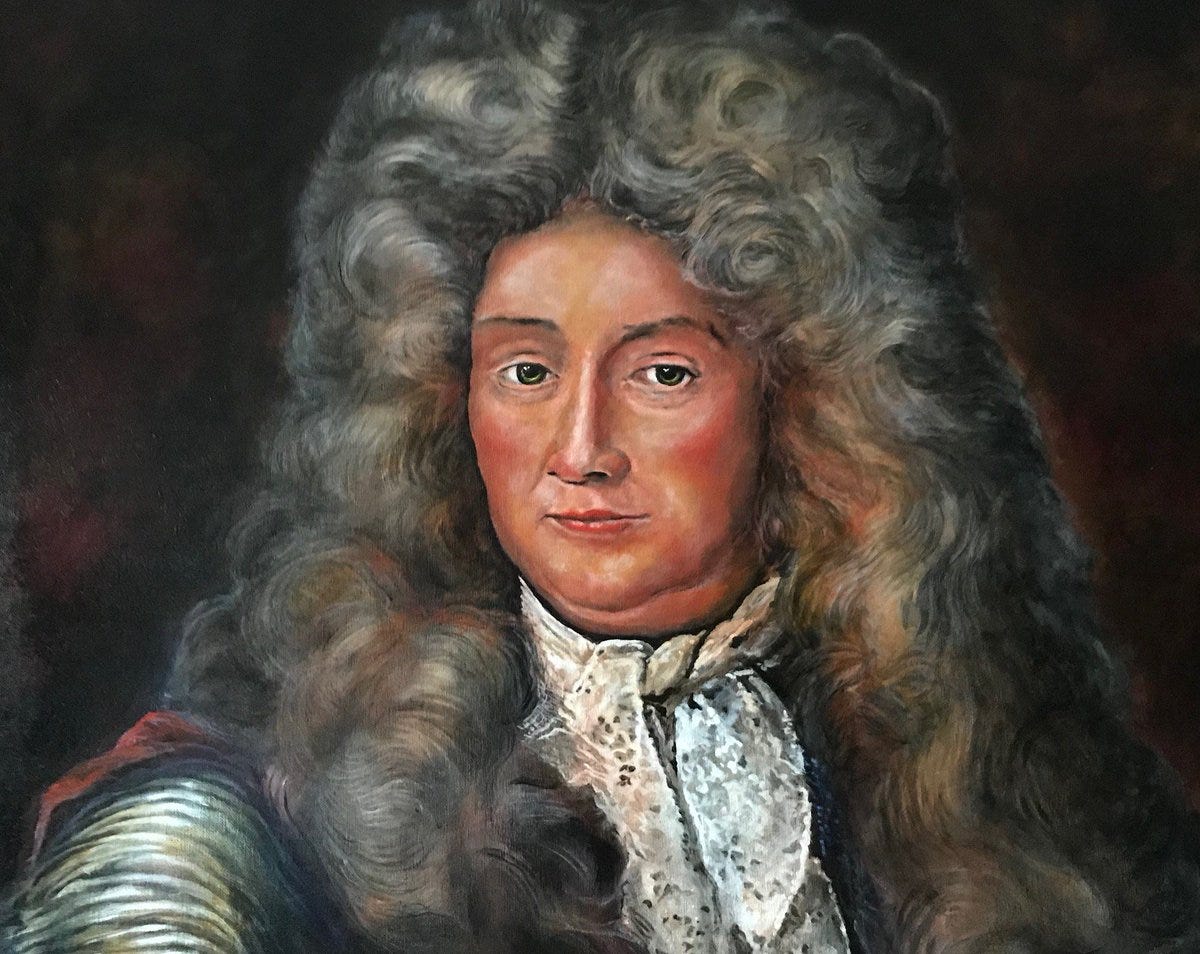
He’s scarcely a household name. His major book, Of the Law of Nature and Nations, is so long and detailed even his admirers call it tedious. It will challenge the memory capacity of advanced e-readers and the patience of advanced human readers. There are nonetheless many reasons Americans (and lovers of liberty in general) should be interested in the philosopher.
Pufedorf’s political concepts are part of the cultural background of the American Revolution. As an important precursor of the German Enlightenment, he was involved in constant quarrels with clerical circles, frequently defending himself against accusations of heresy, despite holding largely traditional Christian views on matters of dogma and doctrine.
Early life
Pufendorf was born at Dorfchemnitz in the Electorate of Saxony, to son of a Lutheran pastor, he was destined for the ministry.
Educated at the Fürstenschule at Grimma, Pufendorf was sent to study theology at the University of Leipzig. The narrow and dogmatic teaching disgusted Pufendorf, and he soon abandoned it for the study of public law.
Leaving Leipzig altogether, Pufendorf relocated to University of Jena, where he formed an intimate friendship with mathematician Erhard Weigel whose influence helped to develop Pufendoff’s remarkable independence of character. Under the influence of Weigel, he started to read Hugo Grotius, Thomas Hobbes and René Descartes.
Pufendorf left Jena in 1658 as Magister and became a tutor in the family of Peter Julius Coyet, one of the resident ministers of King Charles X Gustav of Sweden, at Copenhagen.
At this time, King Charles endeavored to impose an unwanted alliance on Denmark. In the middle of the negotiations, he opened hostilities and the Danes protested vehemently. Coyet succeeded in escaping, but the rest of the staff were arrested and thrown into prison. Pufendorf was held in captivity for eight months. He occupied himself in meditating upon what he had read in the works of Hugo Grotius and Thomas Hobbes, and mentally constructed a system of universal law. At the end of his captivity, he accompanied his pupils, the sons of Coyet, to the University of Leiden.
Career as author
At Leiden, in 1660, Pufendorf was permitted to publish, the fruits of his reflections under the title ”Elements of Universal Jurisprudence: Two Books”). The work was dedicated to Charles Louis, elector palatine, who created for Pufendorf a new chair at the University of Heidelberg, that of the law of nature and nations, the first professorship of its kind in the world. Pufendorf married Katharina Elisabeth von Palthen, the widow of a colleague, in 1665.
In 1667 he wrote, with the assent of the elector palatine, a tract ”On the Present State of the German Empire: One Book”. Published under a pseudonym at Geneva, it was supposed written by a gentleman of Verona, Severinus de Monzambano, to his brother Laelius. The pamphlet caused a sensation. Its author directly challenged the organization of the Holy Roman Empire, denounced in the strongest terms the faults of the house of Austria, and attacked with vigour the politics of the ecclesiastical princes. Before Pufendorf, Bogislaw Philipp von Chemnitz, publicist and soldier, had written, under the pseudonym of “Hippolytus a Lapide”, ”On The Reason of the Present State in Our Holy Roman Empire”). Inimical, like Pufendorf, to the Austrian House of Habsburg, Chemnitz had gone so far as to make an appeal to France and Sweden. Pufendorf, on the contrary, rejected all idea of foreign intervention, and advocated national initiative.
When Pufendorf went on to criticise a new tax on official documents, he did not get the chair of law and had to leave Heidelberg in 1668. Chances for advancement were few in a Germany that still suffered from the ravages of the Thirty Years’ War (1618-1648), so Pufendorf went to Sweden where he was called to the University of Lund.
In 1672 appeared ”On The Law of Nature and of Nations: Eight Books”) and ”On the Duty of Man and Citizen, according to Natural Law” (1673), which, among other topics, gave his analysis of just war theory. Pufendorf took up in great measure the theories of Grotius and sought to complete them by means of the doctrines of Hobbes and of his own ideas on jus gentium (”Law of Man”). His first important point was natural law doesn’t extend beyond the limits of this life but confines itself to regulating external acts. He disputed Hobbes’s conception of the state of nature and concluded the state of nature isn’t one of war but of peace. But this peace is feeble and insecure, and if something else doesn’t come to its aid, it can do very little for the preservation of mankind.
As regards public law Pufendorf, while recognizing in the state (civitas) a moral person (persona moralis), teaches the will of the state is but the sum of the individual wills constitute it, and that this association explains the state. In this a priori conception, in which he scarcely gives proof of historical insight, he shows himself as one of the precursors of Rousseau and of the Contrat social. Pufendorf powerfully defends the idea that international law is not restricted to Christendom, but constitutes a common bond between all nations because all nations form part of humanity.
In 1677 Pufendorf was called to Stockholm as Historiographer Royal, where he wrote ”Introduction to the History of the Most Distinguished Kingdoms and States” and other books and pamphlets. In his historical works, Pufendorf wrote in a very dry style, but he professed a great respect for truth and generally drew from archival sources. His historical works were heavily pro-Swedish and he supported the claim that eastern Denmark was originally Swedish. In 1658 Denmark was forced to cede the eastern provinces of Skåne (Scania), Halland, and Blekinge (plus some Norwegian territories) to Sweden. Pufendorf defended this move and insisted these provinces were “reunited” with Sweden and the Scanian provinces had always belonged to “Götaland”. He wrote “Sweden’s old borders have been healed again”. He traces the limits between ecclesiastical and civil power, propounding for the first time the so-called “collegial” theory of church government which, developed later formed the basis of the relations of church and state in Germany and more especially in Prussia.
This theory makes a fundamental distinction between the supreme jurisdiction in ecclesiastical matters, which Purendorf conceived as inherent in the power of the state in respect of every religious communion, and the ecclesiastical power inherent in the church, but in some cases vested in the state by tacit or expressed consent of the ecclesiastical body. The theory was important because, by distinguishing church from state while preserving the essential supremacy of the latter, it prepared the way for the principle of toleration. It was put into practice to a certain extent in Prussia in the 18th century; but it was not till the political changes of the 19th century led to a great mixture of confessions under the various state governments that it found universal acceptance in Germany. The theory initially found no acceptance in the Roman Catholic Episcopate, but it nonetheless made it possible for the Protestant governments to make a working compromise with Rome in respect of the Roman Catholic Church established in their states.
In ”On the Duty of Man and Citizen”, Pufendorf divides duties into several categories: duties towards God, duties towards oneself, and various forms of duty towards others. Duties towards oneself were classified as “duties of the soul”, such as developing skills and talents, and “duties of the body”, which involve not doing harm to oneself.
Legacy and reputation
John Locke, David Hume, Edward Gibbon, Voltaire, Jean-Jacques Rousseau, and Denis Diderot all recommended Pufendorf’s inclusion in law curricula, and he greatly influenced Blackstone and Montesquieu.
Pufendorf’s feuds with Leibniz diminished his reputation. Pufendorf and Leibniz shared many theological views, but differed in their philosophical foundatation with Pufendorf leaning toward Biblical fundamentalism.
In 1688 Pufendorf was called into the service of Frederick William, Elector of Brandenburg. He accepted the call, but the elector died siddem;u. His son Frederick III fulfilled the promises of his father; and Pufendorf, historiographer and privy councillor, was instructed to write a history of the Elector Frederick William.
The King of Sweden continued his goodwill towards Pufendorf, and in 1694 created him a baron. In the same year while still in Sweden, Pufendorf suffered a stroke, and died on 26 October 1694 in Berlin. He was buried in the church of St Nicholas, where an inscription to his memory is still to be seen. He was succeeded as historiographer in Berlin by Charles Ancillon.
Hello, I hope you’re doing well. I’m a professional artist specializing in comics, NSFW arts (18+), sci-fi, romance , fantasy, book covers, and character design. I’m looking for commissions..I can help turn your novel into a comic also i work on covers, logos, pages, panels, and also adult works. Can I show you my works?