Creek Indian
Another Southern Tribe

The Muscogee, also known as Muscogee Creek or just Creek, are a group of related Indigenous peoples of the Southeastern Woodlands in the United States. Their historical homelands comprised southern Tennessee, much of Alabama, western Georgia and parts of northern Florida.
The ancestors of the Muscogee people were part of the Mississippian cultures. Between 800 and 1600 CE, they built complex cities with earthwork mounds and surrounding networks of satellite towns and farmsteads. Muscogee confederated town networks were based on a 900-year-old history of complex and well-organized farming and town layouts around plazas, ballparks, and square ceremonial dance grounds.
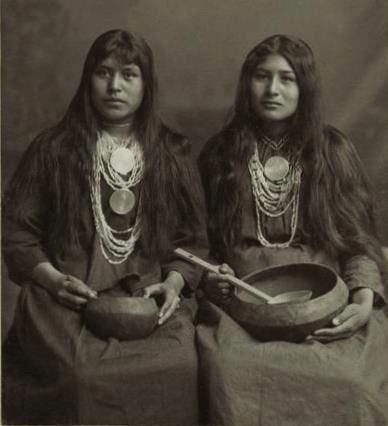
The Muscogee Creek are associated with large moundbuilding communities. Precontact Muscogee polities shared agriculture, transcontinental trade, craft specialization, hunting, and religion. Early Spanish explorers encountered ancestors of the Muscogee in the mid-16th century.
At least 12,000 years ago, Native Americans lived in what is today the Southern United States. Paleo-Indians in the Southeast were hunter-gatherers who pursued a wide range of animals and developed pottery and small-scale horiculture, leading to the Mississippian culture of cultivation of corn (maize) from Mesoamerica led to agricultural surpluses and population growth. Increased population density gave rise to urban centers and regional chiefdoms. Stratified societies developed, with hereditary religious and political elites. This culture flourished in what is now the Midwestern, Eastern, and Southeastern United States from 800 to 1500, especially along the Mississippi River and its major tributaries.
The early historic Muscogee were descendants of the Mississippian culture along the Tennessee River in modern Tennessee, Georgia, and Alabama. They may have been related to the Tama of central Georgia. Muscogee oral history describes a migration from places west of the Mississippi River, in which they eventually settled on the east bank of the Ocmulgee River. Here they waged war against other bands of Native American Indians, such as the Savanna, Ogeeche, Wapoo, Santee, Yamasee, Utina, Icofan, Patican and others, finally overcoming them, though they absorbed some in their tribe as confederates.
In other words, they were invaders.
In the mid-16th century, when explorers from the Spanish made their first forays inland from the Gulf of Mexico, many political centers of the Mississippians were already in decline, or abandoned. The region comprised a collection of moderately sized native chiefdoms interspersed with completely autonomous villages and tribal groups. The earliest Spanish explorers encountered villages and chiefdoms of the late Mississippian culture, beginning in Spring 1513 with Juan Ponce de León‘s landing in Florida. The 1526 Lucas Vázquez de Ayllón expedition in South Carolina also recorded encounters with these peoples.
Muscogee people were gradually influenced by interactions and trade with the Europeans: trading or selling deer hides in exchange for European goods such as muskets, or alcohol. When the Spanish pressed them to identify leaders for negotiations; they seemed not to understand government by consensus.
I’m skeptical, since we know they had chiefs.
Hernando de Soto was a Spanish explorer and conquistador who led the first expedition into the interior of the North American continent. From 1540 to 1543, de Soto explored through present-day Florida and Georgia, and then westward into the Alabama and Mississippi area. The areas were inhabited by historic Muscogee Native Americans.
As the de Soto expedition’s brutalities became known to the Indians, they decided to defend their territory. Chief Tuskaloosa led his people in the Battle of Mabila, where the Native Americans were defeated. The victory came at great cost to the Spanish campaign in loss of supplies, casualties, and morale. The expedition never fully recovered.
Muscogee Confederacy
The Europeans unknowingly brought endemic infectious diseases to the Indians that the Muscogee had no resistence to. This resulted in epidemics of smallpox and measles, and a high rate of fatalities among the tribes. These losses were exacerbated by the Indian slave trade in the Southeast during the 17th and 18th centuries. As the survivors and descendants regrouped, the Muscogee Creek Confederacy arose as a loose alliance of Muskogee-speaking peoples, consisting of Yuchi, Koasati, Alabama, Coosa, Tuskegee, Coweta, Cusseta, Chehaw (Chiaha), Hitchiti, Tuckabatchee, Oakfuskee, and several others tribes.
British, French, and Spanish expansion
Britain, France, and Spain all established colonies in the present-day Southeastern woodlands. Spain established Jesuit missions and related settlements to influence Native Americans. The British and the French opted for trade over conversion. In the 17th century, Franciscan friars in Spanish Florida built missions along Apalachee Bay. In 1670, English colonists from Barbados founded Charles Town (modern-day Charleston) as the capital of the new colony of Carolina. Traders from Carolina went to Muscogee settlements to exchange firearms, gunpowder, axes, glass beads, cloth and West Indian rum for deer pelts, and Indian slaves.
Remember, the Indian tribes practiced slavery. This wasn’t something “white man” taught them.
The Spanish and their “mission Indians” burned most of the towns along the Chattahoochee after they welcomed Scottish explorer Henry Woodward in 1685. In 1690, English colonists built a trading post on the Ocmulgee River where a dozen towns relocated to escape the Spanish and acquire English goods. The name “Creek” most likely derived from a shortening of Ocheese Creek (the Hitchiti name for the body of water known today as the Ocmulgee River), and broadly applies to all of the Muscogee Confederacy.
In 1704, Irish colonial administrator James Moore led the Carolina militia and Ochese Creek and Yamasee warriors on a series of raids against Spanish missions in the Florida interior during Queen Anne’s War. These raids captured thousands of Spanish-allied Indians, primarily Apalachee, who were sold into slavery in Carolina and the West Indies. A decade later, tensions between colonists and Indians in the region led to the Yamassee War of 1715–17.
The Ochese Creeks joined the Yamasee, burning trading posts, and raiding back-country settlers, but the revolt ran low on gunpowder and was put down by Carolinian militia and their Cherokee allies. The Yamasee took refuge in Spanish Florida, the Ochese Creeks fled west to the Chattahoochee. In 1702, French Canadian explorers founded Mobile as the first capital of Louisiana. In 1717, they took advantage of the war to build Fort Toulouse at the confluence of the Tallapoosa and Coosa, trading with the Alabama and Coushatta tribes. Fearing these tribes would come under French influence, the British reopened the deerskin trade with the Lower Creeks, antagonizing the Yamasee, now allies of Spain.
The French instigated the Upper Creeks to raid the Lower Creeks. In May 1718, the shrewd Emperor Brim, mico of the powerful Coweta band, invited representatives of Britain, France, and Spain to his village and, in council with Upper and Lower Creek leaders, declared a policy of Muscogee neutrality in their colonial rivalry. In 1718, the Spaniards built the presidio of San Marcos de Apalache on Apalachee Bay. In 1721, the British built Fort King George at the mouth of the Altamaha River. As the three European colonial powers established themselves along the borders of Muscogee lands, the Muscogee strategy of neutrality allowed them to hold the balance of power.
In 1732, the colony of Georgia was created as a buffer between Spanish Florida and the Carolinas, largely populated with debtors from English prisoners. In 1733, its first settlement, Savannah, was founded on a river bluff where the Yamacraw, a Yamasee band that remained allies of Britain, allowed John Musgrove to establish a fur-trading post. His wife Mary was the daughter of an English trader and a Muscogee woman from the powerful Wind Clan, half-sister of ‘Emperor’ Brim. She was the principal interpreter for Georgia’s founder and first Governor Gen. James Oglethorpe, using her connections to foster peace between the Creek Indians and the new colony. In 1735, Georgia constructed Fort Okfuskee near Oakfuskee to compete with French trade with the Creeks at Fort Toulouse. The deerskin trade grew, and by the 1750s, Savannah exported up to 50,000 deerskins a year.
In 1736, Spanish and British officials established a neutral zone from the Altamaha to the St. Johns River in present-day Florida, guaranteeing Native hunting grounds for the deerskin trade and protecting Spanish Florida from further British encroachment. Around 1750 a group of Ochese moved to the neutral zone, after clashing with the Muskogee-speaking towns of the Chattahoochee, where they had fled after the Yamasee War.
Led by Chief Secoffee (Cowkeeper), they became the center of a new tribal confederacy, the Seminole, remnants of the ‘mission Indians,’ and escaped African slaves. Their name comes from the Spanish word cimarrones, which originally referred to a domestic animal that had reverted to the wild. Cimarrones was used by the Spanish and Portuguese to refer to fugitive slaves—”maroon“ emerges linguistically from this root as well—and American Indians who fled the Europeans.
Intermarriage
Many Muscogee Creek leaders, due to intermarriage, had British names: Alexander McGillivray, Josiah Francis, William McIntosh, Peter McQueen, William Weatherford, William Perryman, and others. In Muscogee culture, unmarried Muscogee women had great freedom over their own sexuality compared to European and European-American counterparts.
Under the customs of Muscogee matrilineal society, their children belonged to their mother’s clan. With the exception of McGillivray, mixed-raced Muscogee people worked against Muscogee Creek interests, in many cases, spearheading resistance to settler encroachment on Muscogee Creek lands. These mixed-raced folks usually spoke English as well as their tribal language, and knew European customs. They occupied a different position in the economy of the Deep South than did most Creeks and Seminoles. They worked as traders and factors. By virtue of their ancestry and upbringing, they had greater cultural, social, linguistic, and geographic ties to the colonial settlements, traveling periodically to Pensacola and the Georgia trading posts to unload their skins and pick up more trade goods.
During the French and Indian War (1754–1763), the Creek Indians (Muscogee) maintained a strategic, neutral balance, playing British, French, and Spanish interests against each other to protect their sovereignty in the Southeast. While the French held Fort Toulouse among the Upper Creeks, the nation largely avoided direct involvement in the conflict, even as their territorial position was critical to protecting the Spanish in Florida and checking British expansion westward.
Following the British victory in 1763 and the exit of the French from America, the Creeks had to readjust their diplomacy to face a single, dominant European power.