Freedom Founded
Pennsylvania was set up for freedom

This is series is on the foundations and Founding Fathers of the United States. Follow this link to the first article in the series.
In March of 1681, King Charles II of England (1630-85) granted William Penn (1644-1718), gentleman and Quaker, the charter for a proprietary colony on the North American continent. Although both English colonial policy and the organization of the Society of Friends, known as Quakers, were works in progress between the years 1682 and 1701, in many ways the pattern of scattered farms and religious tolerance developed in Pennsylvania in those early years became a model for an American way of life.
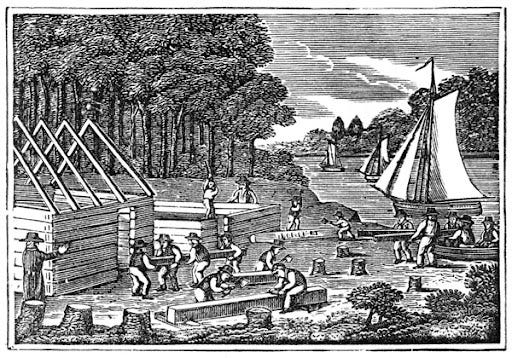
Penn’s grant settled an old debt the king owed to Penn’s father, Admiral William Penn (1621-70), setting the northern border of Pennsylvania at 42 degrees north latitude (the border of New York), and the eastern limit at the Delaware River (the boundary with New Jersey), while the western limit was undefined. Named for the admiral as well as for the woodland it encompassed (Penn’s woods), the new grant differed in form and substance from those offered to proprietors of other colonies.
We libertarians love this. Under the proprietary system, the grantee obtained a charter from the king and established the colony at his own risk. The Crown looked on it as a feudal estate equivalent to independent sovereignty limited only by loyalty to the king. Proprietors could grant titles, had sole authority to initiate laws, levy taxes, coin money, regulate commerce, appoint provincial officials, administer justice, grant pardons, make war, erect manors, and control the land and waterways.
By the time Penn received his “true and absolute proprietary of Pennsylvania,” the powers given to proprietors in British America had become much more limited than the original grants. Penn still had complete control of granting land. At that time, any grant of less than 100 acres constituted a farm. Between 100 and 1,000 acres was a plantation, and grants of over 1,000 acres were a manor. Those holding larger parcels could sell or rent portions of their land as smaller holdings. By 1681, the proprietor no longer had the right to grant titles of nobility, and he had to submit provincial laws to the king for approval, acknowledge the right of Parliament to tax the colony, maintain a provincial agent in London, and present all Pennsylvania laws to the “freemen” or to “their delegates” for approval (this is critical to further developments).
Most disappointing for Penn might have been the added clause giving the established Church of England’s Bishop of London the right to appoint an Anglican minister in Pennsylvania. Penn recruited Quakers, but also Mennonites, and other seperatists from widely dispersed parts of Britain and Europe and saw this clause as making them “dissenters in [their] own Countrey.” However, since his first law code guaranteed religious freedom from the legal penalties and punishments inhibiting the practice of Quakerism and other dissenting Christian groups in England, it was still possible to promote Pennsylvania as a religious refuge for the persecuted.
But you could forecast a looming problem with the Church of England.
In July 1681, Penn issued his first conditions or “concessions” to “adventurers and purchasers”, laying out specifications for a large city on a river, providing for road surveys, creating related grants of city land to country manors, and setting up townships. Penn’s blueprint for Pennsylvania was unique among colonial frames of government by containing several provisions requiring “natives” (Indians) be treated equally with settlers both economically and legally and stating “no man shall. . . in word, or deed, affront, or wrong any Indian.”
The First Frame of Government
Penn followed up the concessions document in May 1682 with the first Frame of Government, which laid out the form and shape of governance in the new colony. The government itself was to consist of the governor, a Provincial Council, and a General Assembly chosen by the freemen who were defined as those who were resident in the province, were free of servitude, owned and cultivated part of their land, and paid a tax to the government.
Twenty-three ships bearing settlers arrived in the new colony between December 1681 and December 1682. The Welcome, William Penn aboard, landed on October 28, 1682. Within two years, 50 ships arrived in Pennsylvania carrying 600 investors and 4,000 settlers. Penn and his colonists entered a land populated by Native Americans and European settlers who provided food and shelter to the newcomers, allowing the new colony to avoid the “starving time” which characterized the fate of other earlier colonies to its north and south. Including the Europeans who settled West New Jersey in the 1670s, there were about 2,500 Lenape Indians and 3,000 Europeans on both sides of the Delaware River when Penn’s colonists arrived.
The inhabitants were diverse. Recognizing who actually owned the land, Penn purchased land on the west bank of the river from the Lenape tribe. The European inhabitants included the Dutch, who had established a trading post in the area in 1624, and Swedes and Finns who created the first permanent settlement of New Sweden in 1638. Most of these settlers lived in the area from what was later Philadelphia to New Castle, Delaware. The Dutch conquered New Sweden in 1655 and then, following England’s victory over the Dutch in 1664, King Charles’s brother, James, Duke of York (1633-1701) took ownership of the west bank of the Delaware River.
Notice, unlike Penn, they didn’t acknowledge tribal ownership.
In 1682, Penn divided the land along the Delaware River into the counties of Chester, Philadelphia, and Bucks, appointing colonists to serve on each county court and administer local government. To allow Pennsylvania an outlet to the sea, in the same year Penn leased from the Duke of York the land south of Chester County on the western shore of the Delaware Bay, setting the border of the “three lower counties” (later the state of Delaware) twelve miles north of New Castle. The charter for Pennsylvania and the lease for the three lower counties remained separate entities represented by a single assembly alternately meeting at Philadelphia and New Castle. By 1704, the inconvenience of this arrangement led to a mutual agreement to set up distinct assemblies and pass laws separately, although they continued to share a governor.
The border between Pennsylvania and Delaware wasn’t actually established until the mid-18th century, with the drawing of the Mason-Dixon line, which also settled the boundary with Maryland.
“Holy Experiment” Did Not Materialize
Penn’s hope for a “Holy Experiment”—where Pennsylvanians did well economically while doing good morally and religiously—failed to materialize. Landed gentleman investors didn’t emigrate as expected, and their investments foundered. The Society of Free Traders was bankrupt within a few years. Penn, himself, never achieved the profits he expected. Although he lived until 1718, he only lived four years in Pennsylvania (1682-84 and 1699-1701) because he struggled with personal and financial problems and had to remain in England to attempt to resolve them.
Penn actually spent time in debtors prison.
Early arrivals who prospered were mostly farmers from northwestern England, an area of scattered farms, along with urban artisans and workmen, many of them from Germany and Holland. Settlers also came from Ireland, Scotland, Wales, and London and its suburbs. By 1690, the population of the colony numbered about 11,500. The principal city of Philadelphia held about 2,000. Ten years later, the colony had close to 18,000 inhabitants, and Philadelphia over 3,000.
Despite popular myth, the Society of Friends was never established as the official religion of the colony and Quakers were always a minority, although their influence was predominant in both the government and the early society.
While religion continued to motivate many settlers, many more were drawn by the rich farmland and its availability. The desire for wealth prompted importation of bound European servants and enslaved Africans. Penn had envisioned a colony of townships, where farms would produce the crops and livestock needed to fuel local centers of government, religion, industry, and trade. Instead, the Thomas Holme 1687 map of Pennsylvania indicates scattered farmsteads became the pattern of settlement for the three counties. Lumbering, grist mills to produce flour, iron-mining operations, small manufactories for textiles, paper, and printing dotted the countryside from the 1690s. By 1701, Philadelphia become the focus of trade, manufacture and civic life, exhibiting most of the attributes of an urban complex and draining the vitality out of potential township centers.
Welsh and German settlers, receiving large grants just outside Philadelphia, made the most determined efforts to maintain their identity. The Welsh Quakers in the Welsh Tract (1684) stood out for their attempts to maintain their own communities with the rights to hold contiguous property, limit the activities of anyone within their boundaries, and govern themselves in their old ways. This didn’t work as assimilation with English Quaker and Anglican settlers overwhelmed the Welsh and the tract survived mainly in Welsh names such as Bala Cynwyd and Bryn Mawr.
Germantown Was Unique
The founding of Germantown and its nature became unique. Through some confusion, Penn granted the same territory to both a group of Dutch Quakers and the German-based Frankfort Land Company whose legal agent was Francis Daniel Pastorius (1651-1720). They arrived at the same time in 1683. As Pastorius was the only member of the company to immigrate, he became, de facto, the leader of the Dutch group, apportioning the land and heading the government. By 1684, the territory acquired its name as it was flooded with German immigrants of many religious sects. The craft occupations of the inhabitants and the distribution of Germantown’s land in small lots strung along a highway leading from Philadelphia to the hinterlands created a miniature urban center. It was chartered as a borough, but failure of the settlers to perform its governmental functions led to loss of that status in 1707. The Quaker meeting retained many of its German beliefs, leading to a protest against slavery in 1688.
Ever since the first “Frame of Government and Laws Agreed Upon in England” in 1682, factions of settlers were dissatisfied with its terms, and it was superseded or amended several times. The colony was taken away from Penn in 1693 on suspicion of treasonable association with James II, but returned to him in 1695, initiating yet another charter in 1696.
The final Charter of Privileges was granted in 1701 since the older frames had all been found “not so suitable to the Present circumstances of the Inhabitants.” The final Charter of Privileges remained in force until the American Revolution. Each frame gradually increased the powers of the elected assembly and as of 1701 it received more privileges than any other legislative body in the English colonies, undoubtedly more than Penn originally intended. A unicameral legislature with its Assembly elected annually could initiate legislation and conduct its own affairs, but the proprietor or his governor retained the right to veto legislation (very similar to how US states work today).
Most significantly, the first clause of the Charter of Privileges reiterated Pennsylvania’s commitment to religious liberty—freedom of worship to all who “acknowledge one almighty God” without attending or belonging to a religious body, and the ability to serve in office by all who believed in Jesus Christ and were willing to affirm allegiance to the government. The affirmation was important to Quakers who refused to swear oaths.
Along with Rhode Island, Pennsylvania was a pioneer of the separation of religion and government in the American colonies.
In coming from South Jersey, 20 miles from Philadelphia, I was interested in the Settlement by Pioneering. I recognized the names of the Native American Indians, Lenape, but there were Delaware Indians which were omitted. Thank you Lela for highlighting the early history and specifically the Separation of Religion. The test of which was institulized although not proven stable