Cocky Young Soldier Gets Lucky
George Washington

This series is on the foundations and Founding Fathers of the United States. Follow this link to the first article in the series.
George Washington was born to Mary Ball and Augustine Washington on February 22, 1732, the third son of a middling planter. George probably should have been relegated to a footnote in a history book, but a series of pivots made him into one of the greatest figures in American history.
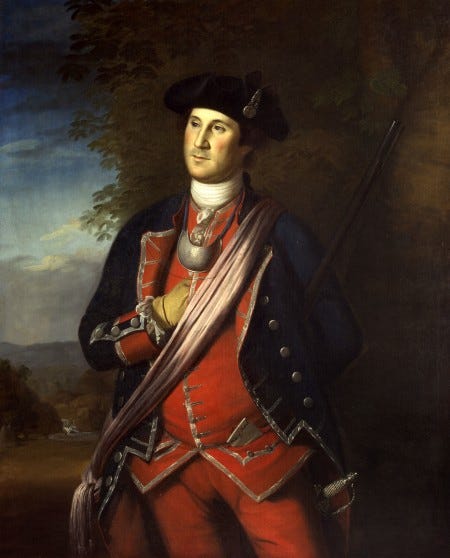
George was Mary Ball Washington’s first child, but Augustine had been married before and had three older children. Over the next several years, the large family moved a few times, finally settling at Ferry Farm on the banks of the Rappahannock River near Fredericksburg, Virginia.
A series of personal losses changed the course of George’s life. His father, Augustine, died when George was 11 years old, ending any hopes of higher education. Thus, Washington spent many of his formative years under the tutelage of Lawrence, his favorite older brother. Without a large inheritance, George relied on family connections to make his way in the world. Unlike his older brothers, he didn’t have the opportunity to study at a university. He spent his teenage years learning how to manage a plantation from his mother and mastering the science of surveying with the assistance of his neighbor, Colonel William Fairfax. While his older brothers inherited most of Augustine’s estate, including Little Hunting Creek Plantation, which later became Mount Vernon, George inherited one of the smaller estates and 10 enslaved individuals who worked the farm.
You’ll notice I skipped over the myth about the cherry tree. There may have been some cherry-tree chopping in his childhood, but the “I cannot tell a lie” part was invented by bookseller Mason Locke Weems in 1806, in the fifth edition of Weems’ biography, The Life of Washington. It’s a fabricated tale highlighting Washington's virtues like honesty and integrity.
In 1751, George accompanied his favorite older brother, Lawrence, on a trip to Barbados. While in the Caribbean, George came down with smallpox. He survived and left the island with lifelong immunity, but the disease probably left him unable to father children and with a firsthand conviction about the dangers of the disease, which we’ll discuss when we revisit Washington during the Revolution.
The trip to Barbados was also formative for Washington’s future. He toured the military structures on the island and became increasingly interested in a military career. Initially, George wanted to join the British Navy, and Lawrence promised to help secure him a position. Mary Ball Washington had strong reservations about the physical abuse her son might receive in the navy and the limited possibilities for advancement. She had a good sense of reality in the British Navy.
With his dreams of naval glory dashed, Washington looked west, particularly the Northwest Territories, where Lawrence was purchasing land. By George’s 17th birthday, he received his first official commission to survey Culpepper County. Just a few years later, Washington had completed almost 200 surveys of more than 60,000 acres. This will be another area of discussion on Washington prior to the Constitutional Convention.
In 1752, George’s older brother Lawrence died, and Washington appeared to lose interest in surveying as a profession and pursued a military career instead. To help his sister-in-law (Lawrence’s widow), he leased Mount Vernon from her.
In October 1753, Washington offered his services to Lieutenant Governor Robert Dinwiddie of Virginia, who planned to send an emissary to meet with the French in the Ohio Valley. Washington had some familiarity with the Ohio Valley from his surveying experience. The governor accepted Washington’s offer, and he headed west. Over the next few months, Washington became convinced the French planned a large military force to attack the British. Eager to warn Dinwiddie, George left the protection of the expedition and made his way on foot with one guide for company. After nearly drowning, freezing, and starving, he arrived in Williamsburg on January 16, 1754.
For his daring service, Dinwiddie promoted the 21-year-old Washington to lieutenant colonel and ordered him to raise men for an upcoming mission to drive the French out of the Ohio Valley. On his way to the Monongahela River, Washington encountered a French scouting party and determined they must be stopped before they revealed his location. He met up with Tanacharison, a local Native American chief, and they made their way to a French camp at Jumonville Glen. According to Washington’s later retelling of the events, he intended to accept the French surrender, but the Native American forces attacked and scalped many French soldiers. During the attack, the French commander, Sieur de Jumonville, was killed.
After the attack, Washington hastily built a small defensive enclosure he named Fort Necessity. On July 3, 1754, French forces surrounded the fort, and by the end of the day, Washington asked for terms of surrender. The French allowed the British forces to leave the fort in return for admitting to the assassination of Jumonville, an official ambassador. The terms were written in French, which Washington couldn’t read. Washington never accepted this explanation, insisting the French forces were spies and the terms were unclear. The attack is thought to mark the start of the Seven Years’ War, but truthfully, the conflict had been brewing for a long time and Washington just stumbled into a situation that triggered it.
After the debacle at Jumonville, Washington joined Brigadier General Edward Braddock’s official family as an aide-de-camp. He accompanied Braddock on his march out west to capture the French Fort Duquesne (now Pittsburgh).
In early 1755, British Major General Edward Braddock and two regiments of Redcoats arrived in Virginia. A 45-year veteran of the British Army, Braddock was named commander-in-chief of all British forces in North America and entrusted with the task of capturing the major French stronghold at Fort Duquesne, near the Forks of the Ohio River (near modern-day Pittsburg).
George Washington was planting his spring crops at Mount Vernon when he received a letter inviting him to serve on Braddock’s personal staff. Washington, 23, became a volunteer aide to the British commander-in-chief. In May, Braddock’s army of some 2,100 British Regulars and 500 colonial militia ventured into the treacherous wilderness and set out for Fort Duquesne.
Washington had warned General Braddock to remain vigilant against ambushes and other improvisational tactics used by the French and Indians, the British commander had no doubts about the military power he wielded. As he once expressed to Benjamin Franklin, “These savages may be a formidable enemy to your raw American militia, but upon the king’s regular and disciplined troops, sir, it is impossible they would make any impression.” That arrogant attitude and ignorance of the cunning fighting ability of the French and Indians would lead to fatal consequences for General Braddock and his soldiers.
After crossing the Monongahela, Braddock’s army was ferociously attacked by the French and their Indian allies in a wooded ravine. British regulars weren’t trained to fight out of formation, as individual men and that’s how Indians attacked, encircling them, using trees of cover and generally cutting Braddock’s troops to pieces before the British even knew they were there. It led to a complete collapse of the command structure, especially after Braddock was mortally wounded during the fighting.
In the midst of the bloody chaos and confusion, George Washington shone as a tower of strength. Though still recovering from a case of dysentery, he reportedly remained fearless under fire and rode all over the battlefield. Washington was so active during the fight that he had two horses shot out from underneath him and four bullets tore through his hat and uniform. Observers and Washington himself considered his survival without serious injury to be a miracle.
He effectively supervised a retreat of the survivors and ensured Braddock was evacuated back across the Monongahela. Among Washington’s responsibilities was an order to ride 40 miles through the night to track down reinforcements under Colonel Thomas Dunbar. After General Braddock’s death and his subsequent burial, Washington helped to guide what remained of the army as it completed its painful retreat.
Regarded as the first major clash in what became the French and Indian War, the Battle of the Monongahela was a crushing British defeat. Of the roughly 1,400 men in Braddock’s army, his force suffered approximately 977 killed or wounded, including 63 officers. Although outnumbered, the 900-man-strong French and Indian force lost only 23 dead and 16 wounded. Despite the overwhelming setback, Washington’s role in saving the remnants of Braddock’s bloodied army from total ruin didn’t go unnoticed. Virginia Lt. Governor Robert Dinwiddie hailed the young Washington as the “hero of Monongahela.”
Washington won promotion for his courage under fire and his efforts to manage an unruly retreat. For the next several years, he served as commander of the Virginia colonial forces before returning his commission at the end of 1758, primarily because he was frustrated by his inability to advance in the British military.
In early 1759, George entered a new chapter in his life when he married Martha Custis, a wealthy widow, and won election to the Virginia House of Burgesses. George and Martha moved to Mount Vernon and embarked on an extensive expansion and renovation of the estate. Their life with her children from her previous marriage, John Parke Custis and Martha Parke Custis, appears to have been loving and warm.
Washington’s position in the House of Burgesses took on additional importance as relations between the colonies and Great Britain deteriorated after the end of the Seven Years’ War. The British government had incurred enormous debts fighting across the globe and faced high military costs defending the new territories in North America it had received in the peace settlement. To defray these expenses, the British Parliament passed a series of new taxation measures on its colonies, which were still much lower than those paid by citizens in England. But many colonists protested they had already contributed once to the war effort and shouldn’t be forced to pay again, especially since they had no input in the legislative process.
Washington supported the protest measures in the House of Burgesses, and in 1774, he accepted appointment as a Virginia delegate to the First Continental Congress, where he voted for non-importation measures, such as abstaining from purchasing British goods. The following year, he returned to the Second Continental Congress after British regulars and local militia forces clashed in Lexington and Concord, Massachusetts. He approved Congress’s decision to create an army in June 1775 and was appointed Commander-in-Chief of the Continental Army.
George Washington has been highly mythologized by his biographers and others. He was brave and bold in times of crisis, and certainly very lucky on the battlefield — there were several bullet holes in his uniform after the Battle of Mongahela, but he suffered no injuries—and his writings suggest a man of deep spiritual foundation, but he was also an extremely ambitious man who craved recognition. That ambition would drive him for his entire life, and drive the country associated with him as well.
I’m not denigrating America’s first president. He was “the necessary man.” I’m just pointing out he was young once and he was very human. None of our Founding Fathers were plaster saints and we shouldn’t believe they were. In some ways, the humanity of the Founding Fathers makes their successful attempts to found a country all the more miraculous. Let’s not make it less than it was.