Glorious Revolution
Looking at the Big Picture

This is series is on the foundations and Founding Fathers of the United States. Follow this link to the first article in the series.
The Glorious Revolution resulted in the removal of King James II from the throne of England in November 1688. He was replaced by his daughter Mary II and her Dutch husband, James’s nephew William III of Orange. The two ruled as joint monarchs of England, Scotland, and Ireland until Mary’s death in 1694, when William became ruler in his own right.
Background
James II became king in 1685 with widespread backing in all three of his kingdoms, despite his conversion to Roman Catholicism while in exile during the English Civil War. June 1685 even saw James successfully crush Protestant uprisings in both Scotland and England, which might have been part of his eventual problems. James failed to appreciate the extent to which his power relied on support from the landed gentry, whose alienation fatally damaged his regime. The vast majority of the gentry in England and Scotland were Protestant. Although Ireland was majority Catholic, a disproportionate portion of the Irish gentry were members of the Protestant Church of Ireland. While, his supporters accepted James’s personal religious beliefs, they wanted him to maintain the primacy of the Protestant Church of England and Church of Scotland. When his policies appeared to undermine them, it destabilised all three kingdoms
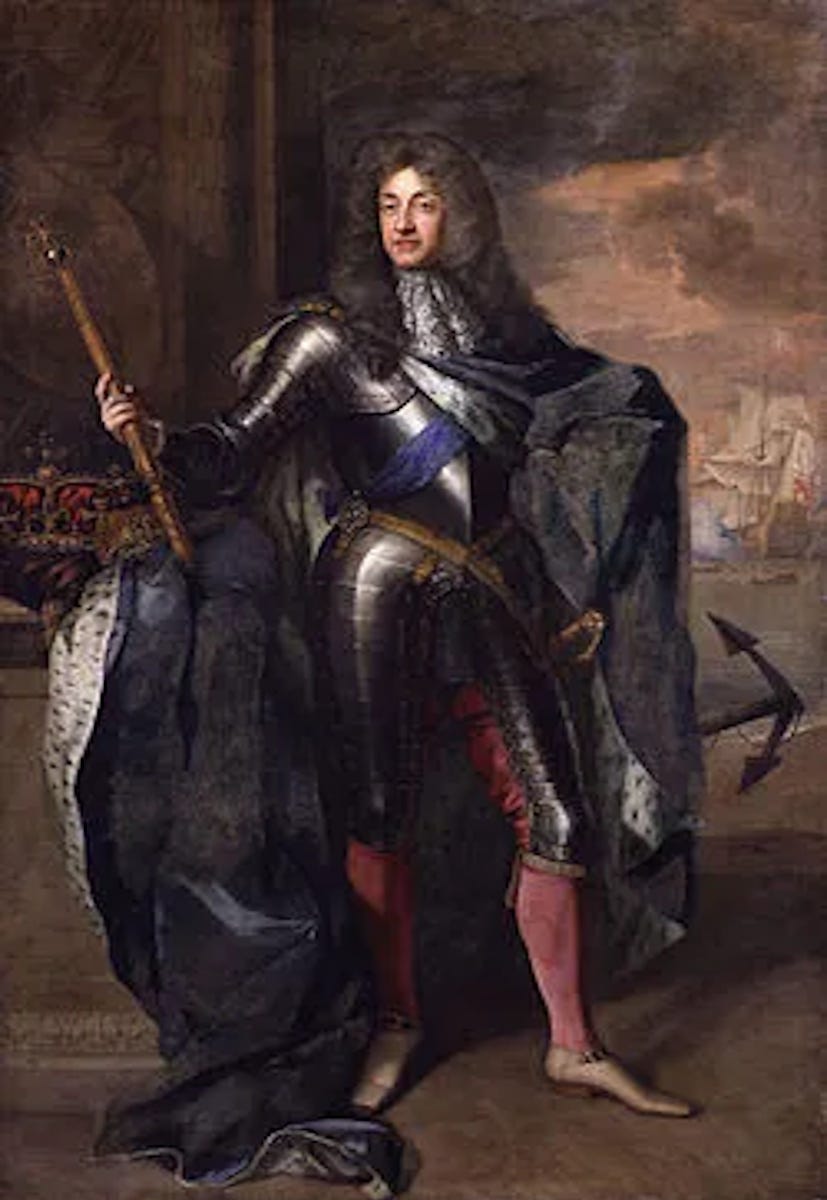
Let’s be clear here — they can call it the Glorious Revolution, but it wasn’t a revolution in the truest sense of the word. It was just another war of succession.
Stuart dynastic political ideology derived from the principle of divine right, which asserted Parliament‘s function was to obey the king. Disputes over the relationship between king and Parliament led to the War of the Three Kingdoms and continued after the 1660 Stuart Restoration. Charles II came to rely on the royal prerogative since measures passed in this way could be withdrawn when he decided, rather than Parliament. It grated on the monarchs when they needed to gain cooperation from Parliament for major legislation or taxation, which weren’t subject to the royal prerogative.
Concern that Charles II intended to create an absolute monarchy led to the 1679 to 1681 Exclusion Crisis, dividing the English political class into those who wanted to ‘exclude’ James from the throne (mostly Whigs who supported Protestant supremacy) and their opponents (mostly Tories, who believed inheritance was based on family). However, by 1685 many Whigs feared the consequences of bypassing the ‘natural heir’, while Tories were often strongly anti-Catholic, and their support assumed the continued primacy of the Church of England. Most importantly, it was seen as a short-term issue; James was 52, his marriage to Mary of Modena remained childless after 11 years, and his heirs were his Protestant daughters, Mary and Anne.
There was much greater sympathy in Scotland for a ‘Stuart heir’, and the 1681 Succession Act confirmed the duty of all to support him, ‘regardless of religion.’ Over 95 percent of Scots belonged to the national church and Catholics were a tiny minority confined to parts of the aristocracy and the remote Highlands. Episcopalians had regained control of the kirk in 1660, leading to a series of Presbyterian uprisings, but memories of the bitter religious conflicts of the Civil War period meant the majority preferred stability.
Most in England and Scotland backed James in 1685, but this wasn’t the case in Ireland. While he was guaranteed support from the Catholic majority, James was also popular among Irish Protestants, since the Church of Ireland depended on Royal support for its survival. Ulster was dominated by Presbyterian Scots who supported his tolerance policies. However, religion was only one factor. Irish Catholics objected to bars against Catholics serving in the military or holding public office, and they wanted land reform. In 1600, 90% of Irish land was owned by Catholics but following a series of confiscations during the 17th century, this had dropped to 22% in 1685. Catholic and Protestant merchants objected to being disadvantaged against their English competitors through a series of commercial restrictions. James supported addressing these objections, which led to objections by devout Anglicans who argued this would be incompatible with the oath he swore to uphold the supremacy of the Church of England.
Demanding tolerance for Catholics was poorly timed. In October 1685, Louis XIV issued the Edict of Fontainebleau, revoking the right of French Protestants to practice their religion, driving an estimated 400,000 into exile. When 40,000 Huguenot refugees settled in London, Protestant Europe felt threatened by a Catholic counter-reformation.
The Protestant Reformation was barely a century old in England.
The majority of those who backed James in 1685 did so because they wanted stability and the rule of law, and his actions undermined that. After suspending Parliament in November 1685, he sought to rule by decree. James II often made things worse by political clumsiness combined with an inability to accept opposition, with a dollop of haughtiness on the side.
Dutch Interference
In 1677, James’s elder daughter and heir Mary married her Protestant cousin William III of Orange. William, viewing French expansion and the expulsion of the Huguenots, assumed another war was inevitable. This view was widely shared throughout Protestant Europe as Protestant states formed the anti-French League of Augsburg, with Dutch support. Securing or neutralizing English resources, especially the Royal Navy, now became key to opposing the French.
As tensions rose between the two monarchs (cousins and inlaws), William worried he might face an Anglo-French alliance, dispite James’ assurances he had no intentions of allying with France. James didn’t fully appreciate the distrust caused by his domestic policies.
In October 1687, after 14 years of marriage and multiple miscarriages, James II’s wife became pregnant. James wrote to his daughter Mary urging her to convert to Catholicism. This convinced many he sought a Catholic heir.
In April 1688, Louis XIV announced tariffs on Dutch herring imports, along with plans to support the Royal Navy in the English Channel. James immediately denied making any such request, but fearing it was the prelude to a formal alliance, the Dutch began preparing a military intervention. On the pretext of needing additional resources to deal with French privateers, in July the States General authorized an additional 9,000 sailors and 21 new warships.
Invitation to William
The Whig Party warned William of an impending domestic overthrow of James II and invited William to invade to “rescue the nation and the religion” before the end of September 1688. William claimed he feared a republic would deprive his wife of her inheritance. The birth of James II’s son, James Francis Edward, solidified plans for the invasion.
As France continued its expansion into the Rhineland, a sense of existential crisis grew. James didn’t trust Louis XIV, but he also seemed unable to repair his relationship with William, or to truly appreciate how his behavior terrified Protestants who still remembered persecution under Mary I, Catholic daughter of King Henry VIII
As Dutch preparations became know, Louie XIV threatened an immediate declaration of war and sent James money to fund a defense. James issued a proclamation for the country to prepare for invasion. William issued the Declaration of The Hague in which he assured his only aim was to maintain the Protestant religion, install a free parliament, and investigate the legitimacy of the Prince of Wales. He promised to spect James’ position. William went on to condemn James’s advisers for overturning the religion, laws, and liberties of England, Scotland, and Ireland by the use of the suspending and dispensing power; the establishment of the “manifestly illegal” commission for ecclesiastical causes and its use to suspend the Bishop of London and to remove the Fellows of Magdalen College, Oxford. William also condemned James’s attempt to repeal the Test Acts and the penal laws through pressuring individuals and waging an assault on parliamentary boroughs, as well as his purging of the judiciary. James’s attempt to pack Parliament was in danger of removing “the last and great remedy for all those evils”.
War!
The French fleet was in the Mediterranean, so not in a position to oppose the Dutch. A strong wind aided the Dutch and hindered the English, who perhaps weren’t trying very hard since they wanted to overthrow James, who had considered himself safe from invasion after France threatened the Spanish Netherlands, but now he panicked. He met with the Protestan bishops, who demanded he restore the Church of England to its previous position and hold free elections for a new Parliament. Although they hoped James to remain king, in reality, he would have to disinherit his son, enforce the Test Acts, and accept the supremacy of Parliament, and no absolute monarch could accept that. James tried to rally his forces, but morale was low and loyalty of some commanders doubtful since officers defected to William. Advised by some of his commanders to retreat, James did, practically admitting defeat.
On November 24, several key commanders, including Princess Anne’s husband George, deserted to support William. Anne herself followed on November 26. On December 8, William made his demands — dismissal of Catholics from public office and funding for the Dutch army. Many of James’ remaining advisers viewed these as a reasonable basis for a settlement, but James decided to flee the country, convinced his life was in danger, even though William had been adament that he wouldn’t allow his uncle to be harmed. Some Tories hoped James could retain his throne if he named a Protestant successor, but the the Whigs preferred to drive him out of the country by imposing conditions he would refuse.
The Queen and Prince of Wales left for France on December 9 with James following separately on December 10 accompanied only by Edward Hales and Ralph Sheldon. Expecting a “papist” invasion, Protestants in London rioted and destroyed Catholic property and then the destruction spread throughout the country. To fill the power vacuum, the Earl of Rochester set up a temporary government including members of the Privy Council and City of London authorities, but it still took them two days to restore order.
James was captured before his departure and escorted back to London. Upon entering the city, he was welcomed by cheering crowds of Tories who hoped a settlement would leave them in government. On December 18, he left Londong with a Dutch escort as William entered, cheered by the same crowds who greeted James less than a week before.
James’ departure enabled William to take control of the provisional government before the end of the year. Parliamentary elections were held in early January. While the Whigs had a slight majority in the House of Commons, the Lords was dominated by the Tories. Both houses were led by moderates. The issue of who would govern the country was debated for next two weeks, while the situation in Ireland deteriorated and the French overran large parts of the Rhineland and prepared to attack the Dutch.[Mary stated she would only rule jointly with her husband. Parliament declared James had abdicated and offered the Crown jointly to William and Mary.
Legacy
The most radical act of the 1688 Revolution was the idea of a “contract” between ruler and people. This rebutted the Stuart ideology of divine right. Technically, this was a victory for the Whigs designed to protect the Anglican establishment from being undermined by future monarchs, including the Calvinist William. The Declaration of Right was a tactical compromise, setting out where James had failed, and establishing the rights of English citizens, without agreeing to their cause or offering solutions. In December 1689, this was incorporated into the Bill of Rights.
But there were other areas that plowed new constitutional ground, two of which were responses to specific abuses by James. First, the Declaration of Right made keeping a standing army without parliamentary consent illegal and vested control of the military in Parliament, not the Crown. Second, the Coronation Oath Act 1688 established obligations owed by the monarchy to the people. Furthermore, at their coronation in April, William and Mary swore to “govern the people of this kingdom of England, and the dominions thereunto belonging, according to the statutes in Parliament agreed on, and the laws and customs of the same”. They were also to maintain the Protestant Reformed faith and “preserve inviolable the settlement of the Church of England, and its doctrine, worship, discipline and government as by law established”.
While the 1688 revolution was labeled “glorious” by Protestant preachers two decades later, it was actually a very complex situation. The Whigs advanced a narrative of the Revolution being a largely consensual and bloodless triumph of English common sense, confirming and strengthening its institutions of tempered popular liberty and limited monarchy, as set forth by Edmund Burke.
Some historians argue William’s invasion was the first phase on the Nine Years’ War because the political turmoil in England in 1688 wasn’t sufficient to produce the overthrow of a king. It’s important to note the Dutch occupation of London rendered Parliament less than free to decide whether they would accept William as their king. British pride and Dutch propaganda tried to depict events as a largely internal English affair, but in truth, the Dutch invaded England and deposed the sitting monarch. j
Other historians reject both these views, seeing the Revolution as a divisive and violent event involving all parts of the English population. In diplomacy and economics, William III transformed the English state’s ideology and policies, not because William III was an outsider who inflicted foreign notions on England but because foreign affairs and political economy were at the core of the English revolutionaries’ agenda. The 17th century was a century of revolution in England and the ideas accompanying the Glorious Revolution were rooted in the mid-century upheavals.
Change was in the wind.
James II tried building a powerful militarised state on the mercantilist assumption that the world’s wealth was necessarily finite, and empires were created by taking land from other states. The East India Company proved an ideal tool to create a vast new English imperial dominion. Standing in stark contrast to writers like John Locke who was active during James’ reign. After 1689 saw the rise of a new understanding of economics, which saw Britain not as an agrarian society, but a commercial one. It led to the foundation of the Bank of England and the creation of Europe’s first widely circulating credit currency, which would eventually lead to Adam Smith (about 90 years later) noting wealth is created by human endeavor and thus potentially infinite.