It Started in Peace
The Pigrim-Wampanoag peace treaty you never heard of

This series is on the foundations and Founding Fathers of the United States. Follow this link to the first article in the series.
In November 1620, the Mayflower arrived in the Americas, carrying 101 English settlers, commonly known as the Pilgrims. The majority of the Pilgrims were Puritan Separatists, who traveled to America to escape the jurisdiction of the Church of England, which they believed violated the biblical precepts of true Christians.
After coming to anchor in the Cape Cod region of Massachusetts, a party of armed men under the command of Captain Myles Standish was sent to explore the immediate area and find a location suitable for settlement. In December, the explorers went ashore in Plymouth, where they found cleared fields and plentiful running water. No doubt, they took this as an auspicious sign of God’s providence. A few days later the Mayflower came to anchor in Plymouth harbor, and settlement began.
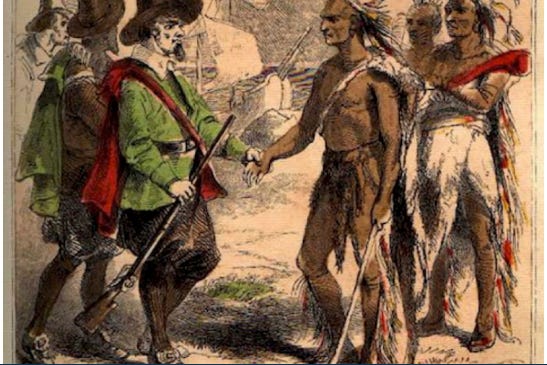
The first direct contact with a Native American was made in March 1621. We’ll deal with that part of the familiar Thanksgiving story in a future article. The first official meeting was when Samoset, a lesser chief of an Eastern Abenaki tribe residing in Maine, paid of visit to the struggling Plymouth Colony.
His tribe had established a fishing camp near an English settlement in Maine and Samoset learned some English from the fishermen. The Abenaki language is an Alognquian languagre related to the Massachusettes language of the Wampnoag people of the Plymouth Colony area. Samoset visited Wampanoag chief Massasoit and decided to go check out the Europeans who had recently arrived. He greeted the colonists in English and asked for beer (seriously, several sources reported he asked for beer). He spent the night with the Pilgrims, then returned at another time with five other Indians who brought deer skins to trade. The colonists declined to trade that day because it was Sunday, but they offered the men some food. Samoset came back on March 22, 1621 with Squanto, the last remaining member of the Patuxet tribe. Squanto spoke much better English than Samoset, and he arranged a meeting with Massasoit.
When Chief Massasoit of the Wampanoags paid a visit, there was an exchange of gifts and the two peoples signed a peace treaty that lasted for more than 50 years.
That’s right. The first British interaction with Native Americans in New England started peacefully and remained so for more than a half-century.
The peace accord, which would be honored on both sides was the first official treaty between English settlers and Native Americans, and a rare example of cooperation between the two groups.
On the orders of their leader, Ousamequin (known to the settlers as Massasoit), the Wampanoags taught the English men and women how to plant crops, where to fish and hunt, and other skills that would prove critical to the new colony’s survival. To celebrate the first harvest at Plymouth, Governor William Bradford and the other settlers invited the Wampanoags for a celebratory feast in November 1621, now remembered as the first Thanksgiving.
As the Wampanoags left few written records, most of what we know of the treaty and its aftermath comes from English chroniclers of Plymouth Colony’s history, namely Bradford and his fellow Pilgrim Edward Winslow. But in focusing on the Plymouth colonists, familiar versions of the story often gloss over the Wampanoags’s motivations for seeking a peace treaty with the English settlers in 1621 and the benefits they_—at least temporarily—_gained from the alliance.
A Devastating Plague
From the moment the Mayflower arrived off the coast of Massachusetts in November 1620, the Wampanoags in the region closely watched the new arrivals while keeping their distance. Previous European explorers, beginning with Giovanni da Verrazzano in 1524, had initially been welcomed for the trade possibilities. That changed after 1614, when Captain Thomas Hunt kidnapped a group of Wampanoags from the community of Patuxet (the future site of Plymouth Colony) to sell into slavery.
Around 1616, an unknown disease (likely unknowingly brought by European traders—remember, nobody had germ theory yet) struck the Wampanoags and other tribes in the region. Candidates for the mysterious disease range from smallpox or measles to yellow fever to cerebrospinal meningitis. Whatever it was, we know the symptoms — headache, spots, sores (pox), and yellowing of the skin.
Whatever the plague was, it decimated the indigenous groups in the region where Plymouth Colony would soon be founded. By one account, the Wampanoag nation lost an estimated two-thirds of its population (about 45,000 people).
By 1620, Wampanoag weakness provided an opportunity for the rival Narragansett tribe to the west, who had largely escaped the impact of the disease. When the Plymouth settlers arrived, Massasoi was struggling to prevent the Narragansett from subjugating the remaining Wampanoags and forcing them to pay tribute. While he initially kept his distance from the Mayflower’s inhabitants, fearing further aggression and, possibly, disease Massasoi evidently concluded an alliance with the new English arrivals could help protect his people.
After sending Samoset, an Abenaki chief (possibly a captive of the Wampanoag) who knew some English, as an emissary to the Plymouth settlers on March 16, 1621, Massasoit arrived about a week later. He and Governor John Carver negotiated the treaty with the help of Tisquantum (Squanto), a Wampanoag from Patuxet who had been among the group captured by Hunt in 1614. Tisquantum had managed to escape slavery and lived for a number of years in England before returning home in 1619 aboard another English ship.
Bradford and Winslow were aware of the Wampanoag and Narragansett rivalry and willing to share their strength and arms with them in order to keep peace with their immediate neighbors.
Lasting Impact of the 1621 Peace Treaty
For the Pilgrims and other settlers at Plymouth Colony, the peace treaty with the Wampanoag meant learning the farming skills they needed to attain that first successful harvest. For Massasoit, the treaty meant preserving his people’s autonomy and his own power and influence, even though some Wampanoags bitterly disagreed with his decision to align with the English colonists.
Bradford and Winslow continued to honor the treaty with the Wampanoags. Despite periodic tensions, peace between the two groups survived until after Massasoit’s death in 1661, making the 1621 treaty the only one between Native Americans and English colonists to be honored throughout the lives of all who signed it.
The peace wouldn’t last. Massasoit’s first son and successor, Wamsutta, died in 1662 amid negotiations with the colonists over land. He was succeeded by his brother, Metacom (later known as King Philip) who claimed Wamsutta had been poisoned. Who was he poisoned by? Metacom insisted Wamsutta was poisoned by the English, but historians believe he might have been poisoned by Metacom because there’s some historical evidence of Metacom poisoning others.
Escalating tensions between Plymouth Colony and a coalition of tribes under Metacom’s command would explode into King Philip’s War (1675-78), a bloody conflict leading to Metacom’s execution in 1676 and the killing or capture of thousands of American Indians.