John Adams
A Reasonable Man

This series is on the foundations and Founding Fathers of the United States. Follow this link to the first article in the series.
John Adams (1735 –1826) was a leader of the American Revolution, Founding Father, US diplomat to Europe, and the second president of the United States from 1797 to 1801 as well as the first vice president of the United States, serving from 1789 to 1797. A dedicated diarist who regularly corresponded with contemporaries, including his wife and advisor Abigail Adams and his friend and rival Thomas Jefferson, his writings provide us with much of our insight into the motivations of the Independence movement.
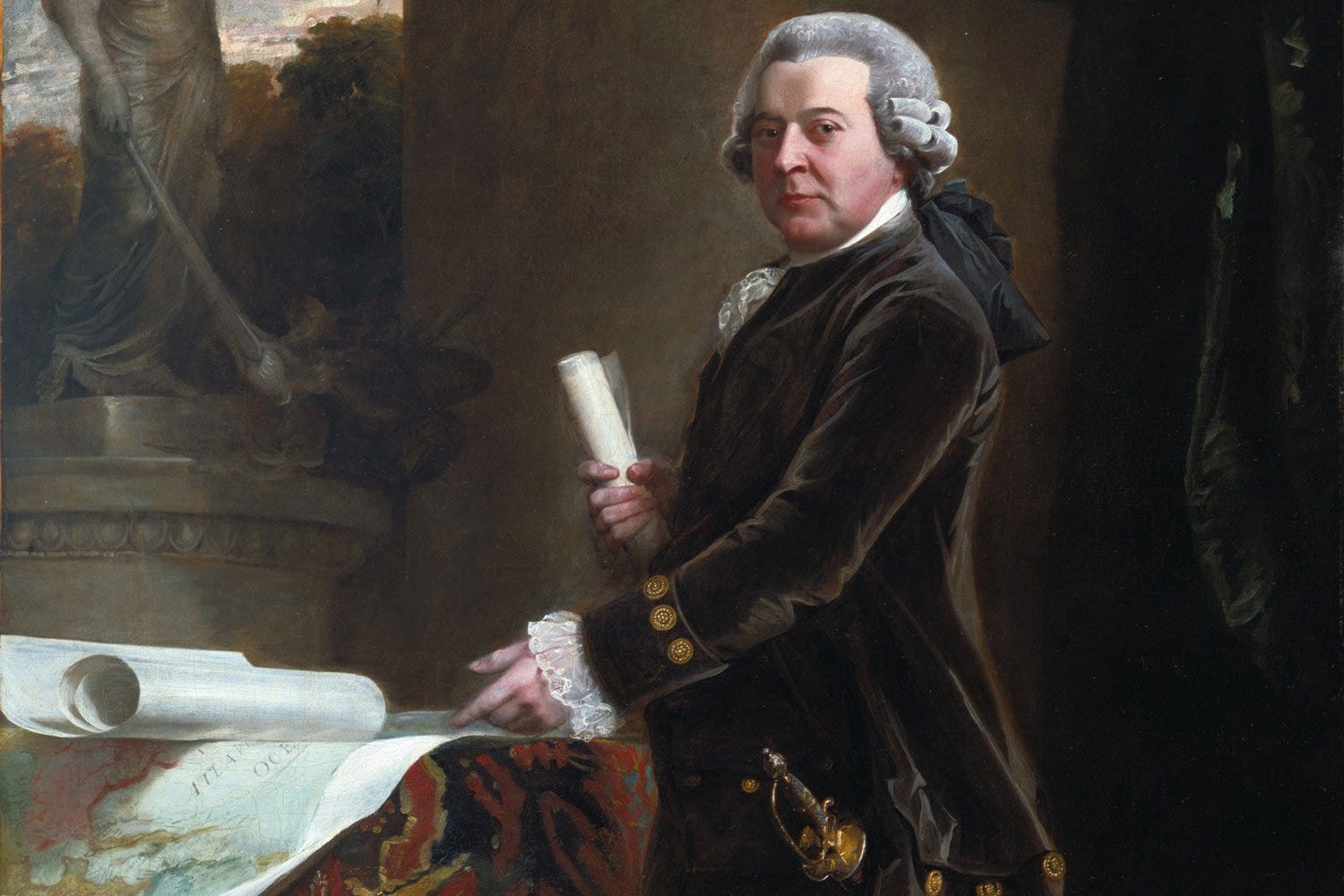
John Adams was born on October 30, 1735, to John Adams Sr. and Susanna Boylston, on the family farm in Braintree, Massachusetts. His mother was from a leading medical family and his father was a deacon in the Congregational Church, a farmer, a cordwainer, and a lieutenant in the militia. Adams often praised his father and recalled their close relationship. Adams’s great-great-grandfather Henry Adams immigrated to Massachusetts from Braintree, Essex, England, around 1638.
In other words, he was thoroughly American.
Adams’s formal education began at age six at a dame school, conducted at a teacher’s home and centered on The New England Primer. He then attended Braintree Latin School under Joseph Cleverly, where studies included Latin, rhetoric, logic, and arithmetic.
Yes, this would have been when he was of elementary school age! This was standard education for the time period.
Adams’s early education included incidents of truancy, a dislike for his master, and a desire to become a farmer, but his father required he remain in school. Deacon Adams hired a new schoolmaster named Joseph Marsh, to whom his son responded positively.
At age sixteen, Adams entered Harvard College in 1751, studying under Joseph Mayhew. As an adult, Adams was a keen scholar, studying the works of ancient writers such as Thucydides, Plato, Cicero, and Tacitus in their original languages. Though his father expected him to become a minister, after young John’s 1755 graduation, he taught school temporarily in Worcester, while pondering his permanent vocation. In the next four years, he began to seek prestige, craving “Honour or Reputation” and “more defference from [his] fellows”, and was determined to be “a great Man”. He decided to become a lawyer, writing his father that he found among lawyers “noble and gallant achievements” but, among the clergy, the “pretended sanctity of some absolute dunces”. He had reservations about his self-described “trumpery” and failure to share the “happiness of [his] fellow men”.
When the French and Indian War began in 1754, Adams, 19, felt guilty he was the first in his family not to be a militia officer.
“I longed more ardently to be a Soldier than I ever did to be a Lawyer”.
In 1756, Adams began reading law under James Putnam, a leading lawyer in Worcester. In 1758, he earned an A.M. from Harvard, and was admitted to the bar in 1759. He developed an early habit of journaling including his impressions of James Otis Jr.‘s 1761 challenge to the legality of British writs of assistance, which allowed British officials to search a home without notice or reason. Otis’s argument against the writs inspired Adams to the cause of the American colonies.
In 1763, Adams explored aspects of political theory in seven essays written for Boston newspapers. Under the pen name “Humphrey Ploughjogger”, he ridiculed the selfish thirst for power he perceived among the Massachusetts colonial elite. Adams was initially less well known than his older cousin, Samuel Adams, but his influence emerged from his work as a constitutional lawyer, his analysis of history, and his dedication to republicanism. Adams often found his own irascible nature a constraint in his political career.
In the late 1750s, Adams fell in love with Hannah Quincy and almost proposed to her. In 1759, he met 15-year-old Abigail Smith, his third cousin. Adams initially wasn’t impressed with Abigail, finding she and her two sisters insincere and standoffiish, but over time, Adams grew close to Abigail. They were married on October 25, 1764, despite the opposition of Abigail’s mother. The pair shared a love of books and proved honest in their praise and criticism of each other. After his father’s death in 1761, Adams inherited a farm and a house where they lived until 1783.
John and Abigail had six children, four who lived to adulthood. All three of Adams’s sons became lawyers. Charles and Thomas were largely unsuccessful and became alcoholics. In contrast, John Quincy excelled and launched a political career, eventually becoming president himself.
A Prudent Reformer
Adams rose to prominence leading widespread opposition to the Stamp Act. Parliament passed the Act, requiring payment of a direct tax for all stamped documents, without consulting colonial American legislatures and gave power of enforcement to British vice admiralty courts, rather than common law (American) courts. These Admiralty courts acted without juries, and the Act was despised for both its monetary cost and implementation without colonial consent. Adams authored the “Braintree Instructions“ in 1765, which was sent to the representatives of Braintree in the Massachusetts legislature. It explained the Act should be opposed since it denied two fundamental rights guaranteed to all Englishmen (and which all free men deserved). They had a right to oppose taxes issued without their consent and a right to trial by a jury of one’s peers. Succinct and forthright, concentration on colonial rights and liberties, the Instructions served as a model for other towns.
“Humphrey Ploughjogger” also opposed to the Stamp in four articles in the Boston Gazette that were republished in The London Chronicle in 1768 as True Sentiments of America, or A Dissertation on the Canon and Feudal Law. Adams spoke before the governor and council, pronouncing the Stamp Act invalid in the absence of Massachusetts representation at Parliament. In this speech, he explained many protests were sparked by a popular sermon of Boston minister Jonathan Mayhew, which invoked Romans 13 to justify insurrection. While Adams strongly opposed the Act in writing, he rebuffed attempts by his cousin Samuel Adams, a leader in the popular protest movements, to involve him in mob actions and public demonstrations. Seen as a man of restraint who was nevertheless on the Patriot side, Adams was elected as Braintree selectman in 1766.
With the repeal of the Stamp Act in early 1766, tensions with Britain temporarily eased. Putting politics aside, Adams moved his family to Boston in April 1768 to focus on his law practice. The family rented a house on Brattle Street, then at Cold Lane, and then to a larger house in Brattle Square. In 1768, Adams successfully defended the merchant John Hancock, accused of violating British acts of trade in the Liberty Affair, becoming Boston’s most prominent lawyer. In 1770, Adams succeeded James Bowdoin as a member of the Massachusetts House of Representatives. He served in this capacity until April 16, 1771.
Boston Massacre
Britain’s passage of the Townshend Acts in 1767 revived tensions, and an increase in mob violence led the British to dispatch more troops to the colonies. On March 5, 1770, when a mob accosted a lone British sentry, eight of his fellow soldiers reinforced him, and the crowd around them grew to several hundred, pelting the soldiers with snowballs, ice, and stones. In the chaos, the soldiers opened fire, killing five civilians, in what became known as the Boston Massacre. The accused soldiers were arrested on charges of murder. When no other attorneys would come to their defense, Samuel Adams convinced John Adams to represent them despite the risk to his reputation. Both Adamses believed no person should be denied the right to counsel and a fair trial. The trials were delayed so passions could cool.
The week-long trial of the commander, Captain Thomas Preston, began on October 24 and ended in his acquittal when the American colonial jury found it impossible to prove he ordered his soldiers to fire. The remaining soldiers were tried in December when Adams made his famed argument regarding jury decisions: “Facts are stubborn things; and whatever may be our wishes, our inclinations, or the dictates of our passions, they cannot alter the state of facts and evidence”. Adams won an acquittal for six of the soldiers. Two, who had fired directly into the crowd, were convicted of manslaughter.
To select that jury, Adams “expertly exercised his right to challenge individual jurors and contrived what amounted to a packed jury. Not only were several jurors closely tied through business arrangements to the British army, but five ultimately became Loyalist exiles.” While Adams’s defense was helped by a weak prosecution, he “performed brilliantly.”
The prosperity of his law practice increased from this exposure, as did the demands on his time. In 1771, Adams moved his family to Braintree, Massachusetts, but kept his office in Boston, which allowed him to concentrate more fully on his practice. After some time in the capital, he became disenchanted with the rural and “vulgar” Braintree as a home for his family so he moved them back to Boston in August 1772. He purchased a large brick house on Queen Street, not far from his office. In 1774, Adams and Abigail returned the family to the farm due to the increasingly unstable situation in Boston, and Braintree remained their permanent Massachusetts home.
American Revolution
Adams, who had been among the more conservative of the Founding Fathers, persistently asserting the British actions against the colonies were wrong, but open insurrection wasn’t warranted and peaceful petition with the view of remaining part of Great Britain was preferable. His ideas began to change around 1772, as the British Crown assumed payment of the salaries of Governor Thomas Hutchinson and his judges instead of the Massachusetts legislature. Adams wrote in the Gazette these measures would destroy judicial independence and place the colonial government in closer subjugation to the Crown. Hutchinson delivered a speech asserting Parliament’s powers over the colonies were absolute and any resistance was illegal. John Adams, Samuel, and Joseph Hawley drafted a resolution adopted by the House of Representatives threatening independence as an alternative to tyranny. The resolution argued the colonists weren’t, and had never been, under the sovereignty of Parliament: their charter, as well as their allegiance, was exclusive to the King.
The Boston Tea Party, a demonstration against the Tea Act and the British East India Company‘s tea monopoly over American merchants, took place on December 16, 1773. Protestors boarded the British schooner Dartmouth, anchored in Boston harbor , demolished 342 chests of tea worth about ten thousand pounds. The Dartmouth owners briefly retained Adams as legal counsel regarding their liability for the destroyed shipment, but Adams applauded the destruction of the tea, calling it the “grandest Event” in the history of the colonial protest movement, and writing in his diary that it was an “absolutely and indispensably” necessary action.
Again, we’ll come back to Adams at a later date so as to retain our focus on the events leading up to the Revolution.