John Smith
He believed in the American project

This series is on the foundations and Founding Fathers of the United States. Follow this link to the first article in the series.
When people think of Virginia, they often think of John Smith, which is somewhat surprising, since he had no descendants. He was too busy exploring the world to marry and father children. In his writings, he claimed England’s New World colonies as his offspring: “I may call [the colonies] my children for they have bin my wife, my hawks, my hounds, my cards, my dice and in total my best content.
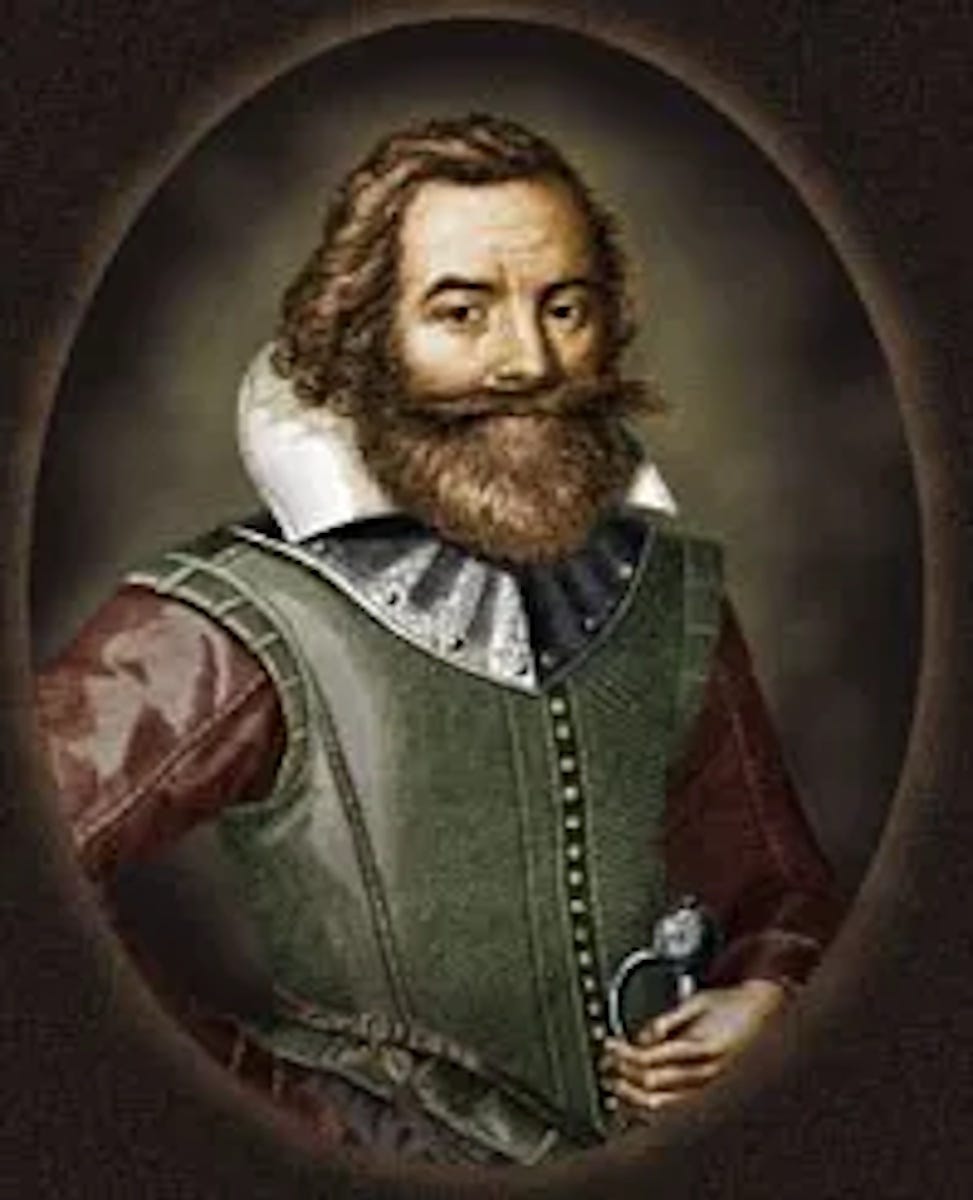
Smith wanted the colonies to succeed for England, but also because he had invested so much of himself in them.
A Rough and Tumble Life
Smith was well-qualified for the challenges of leadership in a new settlement. Born to a farmer, Smith was apprenticed to a merchant, but spent his time studying warfare in England. When his father died, he broke his apprenticeship and set out for Europe, where he and other Englishmen fought with the Dutch against the Spanish. He also survived a shipwreck and somehow joined a Mediterrean pirate fleet, which made him a rich man at only 20 years of age.
In 1600, he joined the Austrian forces fighting against the “infidel” Turks in Hungary and Transylvania. The Turks probably thought he was the infidel since that’s how their faith designates anyone who isn’t a Muslim, but especially after he beheaded three Turkish officers.
To be fair, Smith didn’t start it.
Smith proved to be a highly creative soldier who could draw on his military studies. During the battle for Limbach, a German fortress town besieged by the Turks, Smith drew on his military readings to devise a signaling system allowing his regiment to communicate with the Austrian garrison trapped inside. Using the torches, the garrison was told the Austrian forces sent to liberate them would charge to the east of the town after nightfall. The garrison should be ready to support their attack.
The night of the battle, Smith used string, cloth, and powder to create the illusion of two thousand muskets firing to the west of Limbach. In the pitch black night, the Turks mistook the flashes of light for an Austrian attack. They moved their forces to the west, leaving the eastern side of town relatively defenseless, and the Austrians moved in. When morning dawned, the Turkish commander realized he’d been defeated, lifted the siege, and retreated. For his contributions to the Austrian victory, Smith was promoted to captain and put in charge of a company of 250 men on horseback.
During the siege of Alba Regalis, a Turkish commander named Lord Turbashaw challenged any Christian captain to single combat, with the victor taking the head of the loser. He probably expected Christian heads to roll. Lots were drawn among the Christian officers, and the challenge fell to John Smith. Smith killed and beheaded Lord Turbashaw, then second and third Turks, seeking revenge, also challenged him and suffered the same fate.
A couple of months later, Smith was grievously wounded, captured and sold as a slave. Slavery was quite common among Muslim societies, who often kidnapped Europeans for this purpose. In fact, the word “slave” comes from the term “Slav”, the people of the area in which Smith was captured. His new master assigned him to be the slave of the Christian slaves — the lowest of the low. Malnourished and abused, Smith used his captivity to learn the Turkish language and plot escape. His chance came one afternoon while threshing wheat in an isolated field. His master decided to beat him and Smith bashed in his head with the threshing bat. Knowing that discovery and capture meant torture and death, Smith hid the body under some straw, donned his master’s clothes, stole his horse, and rode off into the desert. It would be almost a year before Smith found his way back to England in 1604, having made his way through Morocco.
When the Virginia Company recruited settlers in 1606, Smith volunteered. Well-traveled and experienced well beyond his years, Smith was among the youngest chosen to lead the new colony in the wilds of North America.
Events on the sea voyage to Virginia intensified circumstances among the settlers. At odds with some of the gentlemen who charged him with attempting to organize a mutiny, Smith spent most of the voyage restrained.
It seems John was perfectly suited to the adventurer’s life, but he had problems with authority. How very American of him!
On arrival at Cape Henry in late April 1607, the names of the seven-member council were read. One of them was the still-restrained Smith. How awkward! Released in early June, Smith took his place on the council and was soon named Cape Merchant and placed in charge of procuring goods and supplies from the local environment and the indigenous people.
During the autumn of 1607, problems developed between members of the council. President Edward Maria Wingfield was accused of hoarding supplies for himself, deposed and placed in restraint on the Discovery, anchored in the James River. Captain Bartholomew Gosnold died from illness. Captain George Kendall was executed on charges of mutiny. The remaining council members made attempts at replacing these men, but within little more than a year, Smith was the sole remaining councilor and de facto colony leader.
Opinions vary on whether Smith was conniving enough to have done this to his fellow councilmen, but they did arrest him on the voyage over, so he may not have been unhappy with some of the tragedies that befell his accusers.
Smith explored the Chesapeake Bay area twice, recording his observations in written descriptions and on a detailed map. He sharpened his skills as a trader and diplomat through encounters with Powhatan tribes and survived capture by Powhatan’s warriors in December 1607, which was when he met Pohantos, who would have been a child at the time. Unlike the Disney cartoon, it never developed into a romance. That would have been creepy.
The English colonists had a desperate need for food and Smith met with Virginia Indian leaders numerous times to entice them to trade with him. He became president of the colony in the autumn of 1608 and with this authority, he strengthened defenses, enforced discipline, and continued to seek food from the Virginia Indians.
Smith required colonists to work if they wanted to be fed, ordering that: “He that will not worke, shall not eat.” Smith trained the colonists in military skills and dealt effectively with the Virginia Indians in trade and political negotiations.
Eventually, his assertiveness angered local tribes and his own countrymen. When former colonists—and antagonists—Gabriel Archer and John Ratcliffe returned to Virginia in late summer 1609, they plotted to take Smith’s life. They sent an assassin to shoot Smith who had recently been badly burned in a gunpowder explosion, but the gunman couldn’t go through with it and Smith returned to England for treatment.
At home in England, Smith kept faith in the Virginia colony. He also supported a new colony to the north, New England. In 1614, he successfully explored there, recording his observations in descriptions and on a map. His hopes for establishing a colony in New England were dashed when he was captured by French pirates in 1615.
Escaping the pirates, Smith returned to England, where he wrote about his exploits and adventures. Smith never returned to sea. He died in London in 1631, almost penniless, but still promoting his “children” in the New World.
Smith may have a reputation of being assertive and self-serving, but his writings about the Powhatan Indians and descriptions of the land of Virginia have been invaluable sources for historians and ethnographers. His map of Virginia was used by settlers to Chesapeake Bay for half a century. Many historians believe the Virginia colony’s success was due to John Smith’s early activities.