John Wesley
A church-goer becomes a man of God

This series is on the foundations and Founding Fathers of the United States. Follow this link to the first article in the series.
John Wesley (1703–1791) was an Anglican evangelist, theologian, and co-founder of Methodism. Wesley was born in the small English town of Epworth and was the 15th child of Samuel and Susanna Wesley. John’s father was an Anglican priest and rector
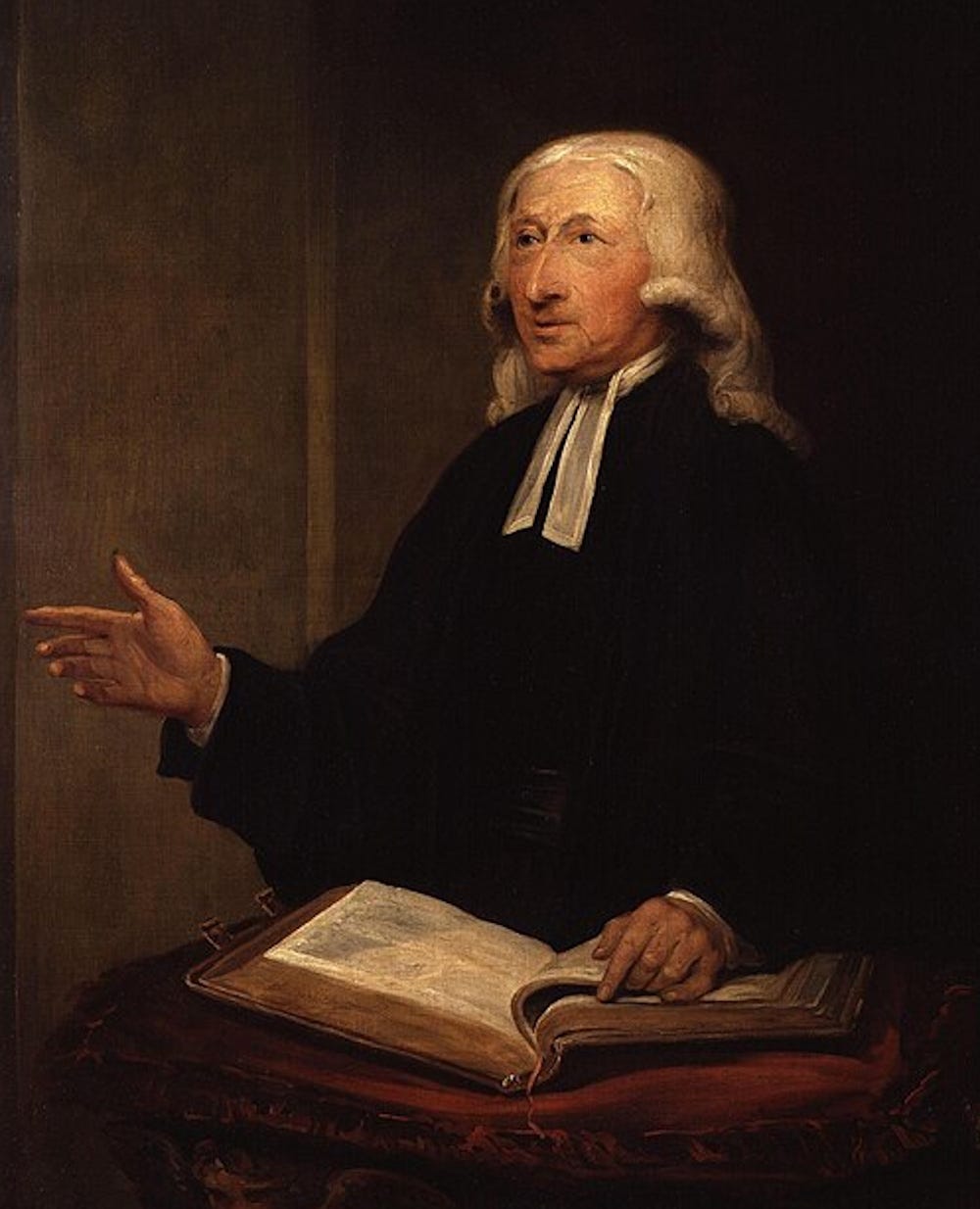
Originally schooled at home, John and his siblings were expected to learn English, Greek, Latin and French and their mother Susanna was quite strict in how she taught them. A rectory fire in 1709, when he was five years old, left an indelible impression. Some time after 11:00 pm, the rectory roof caught on fire. Sparks falling on the children's beds and cries of "fire" from the street roused the Wesleys who managed to shepherd all their children out of the house except for John who was left stranded on an upper floor. With stairs aflame and the roof about to collapse, Wesley was lifted out of a window by a parishioner standing on another man's shoulders. This childhood deliverance seemed to attest to a special destiny.
John decided to enter the ministry like his father, and he trained at Oxford. There, he began meeting with another group of students, which included his brother Charles and George Whitfield. They would pray, study Scripture, and observe communion. Fellow students mocked them as “the Holy Club”, “Bible bigots” and “Methodists” because of the prescribed method of spiritual disciplines they followed. Of course, Methodist would later become the name by which those who followed the prescribed spiritual disciplines would choose to be called.
In 1735 John traveled to the American colonies to become the parish pastor in Savannah, Georgia, and also to do mission work among the Native Americans. On the trip across the Atlantic, his ship was caught in a violent storm. John cowered in fear of his life, but he noticed that a group of Moravians seemed to have no fear of death whatsoever. Wesley recognized the Moravians had something he lacked. When his ministry in Savannah lasted only two years, marked by difficulty, ineffectiveness, and even scandal, he returned to England.
John rightfully assessed himself as needing salvation, which explained his fear of death and ineffectiveness in ministry. He trained as a clergyman and practiced spiritual disciplines, but he’d never truly come to faith in Christ for himself. He wrote in his journal on December 2, 1737, “I went to America to convert the Indians; but O! who shall convert me?” Spiritual disciplines such as prayer, Bible reading, and fasting are helpful for a believer to strengthen and deepen a relationship with Christ, but without faith in Christ and becoming born again by the Spirit of God no amount of spiritual discipline will ever bring about spiritual life.
Upon his return to England, John Wesley came under the influence of a Moravian minister who taught him further about justification by faith and assurance of salvation. On May 24, 1738, Wesley made a journal entry that is now famous. As Wesley heard someone read a passage from Martin Luther’s preface to Romans, he had a conversion experience: “While he was describing the change which God works in the heart through faith in Christ, I felt my heart strangely warmed. I felt I did trust in Christ, Christ alone for salvation: and an assurance was given to me that he had taken away my sins, even mine, and saved me from the law of sin and death.” Thus John joined his brother Charles in true faith in Christ.
Although thoroughly evangelical, John Wesley rejected the doctrine of election and also subscribed to the doctrine of Christian perfectionism or entire sanctification. Wesleyan theology today is noted for its Arminian stance.
After his conversion, John Wesley began enthusiastically preaching the gospel wherever he could. He began holding “Methodist” meetings outdoors, and revival broke out. Methodism became recognized as an evangelical movement within the Church of England, and John remained a loyal member of the Anglican Church all his life, even as his followers began forming themselves into a new denomination. Wesley felt any Christian could be a “methodist” and remain loyal to his own church.
Wesley said he viewed the world as his parish. He teamed with George Whitfield and preached with great success in the New World. It’s estimated John Wesley covered a quarter million miles on horseback during his lifetime, as he brough the full gospel to England, Ireland, and Scotland, preaching over 40,000 sermons. Since trained ministers weren’t generally sympathetic to Wesley’s kind of ministry, he trained laymen to become itinerate preachers—Methodist “circuit riders” to circulate throughout the countryside and hold services. Besides preaching the gospel, John Wesley was active in social reform causes including abolition, prison reform, and easy access to education.
John Wesley’s ministry changed the religious landscape of England and the American colonies, and his influence is still being felt today. His The Journal of John Wesley is a classic of Christian literature. The Methodist and Wesleyan churches around the world owe their existence to John Wesley’s leadership and vision.