Pequot War
Setting a tone for what would come

This series is on the foundations and Founding Fathers of the United States. Follow this link to the first article in the series.
While the Pilgrims managed to live in peace with their neighbors, things didn’t always go smoothly between other colonies and their American Indian neighbors.
If you’re bothered by my use of American Indian rather than Native American, ask me why I CHOOSE one term over the other. It is deliberate.
Before the Pequot War (1636-1637), the Pequot occupied approximately 250 square miles of territory in southeastern Connecticut, surronding what is now Groton, Ledyward, Stonington, North Stonington and southern parts of Prestone and Griswold. The Thames and Pawcatuck Rivers formed the western and eastern boundaries, Long Island Sound was to the south, and Preston and Griswold formed the northern boundary. Some historic sources suggest the Pequot territory extended four to five miles east of the Pawcatuck River to an area called Weekapaug in Charlestown, Rhode Island prior to the Pequot War.
Within this territory during the early 17th century lived some 8,000 Pequot men, women and children (4,000 after the smallpox epidemics of 1633-1634), residing in 15-20 villages of between 50 to 400 people.. These villages were located along the estuaries of the Thames, Mystic, and Pawcatuck Rivers and Long Island Sound.
Roots of War
There’s more to a war between Indians and settlers than just the settlers didn’t belong there and the Indians had finally had enough abuse. As we’ve seen with the Pilgrims, peace was possible.
Understanding the Pequot War requires examining the broader cultural, political and economic changes occurring in the wake of the arrival of the Dutch in 1611 and English in the early 1630’s.
The Pequots weren’t innocent victims of what would later happen to them. To control the fur and wampum trade during the 1620’s, the Pequot attempted to subjugate other tribes throughout Connecticut and the offshore islands. By 1635, the Pequot had extended their control through a tributary confederacy of dozens of tribes created through coercion, warfare, diplomacy, and intermarriage.
For a time, the Dutch and Pequot controlled all trade in the region which resulted in short-term stability while creating a potentially volatile situation. Many Native tribes resented of their tributary status to the Pequot. The arrival of English traders and settlers in the Connecticut River Valley in the early 1630’s shifted the delicate balance between the regional bullies and their subjugated neighbors.
The arrival of the English in the Connecticut River Valley resulted in intense competition and conflict for control of trade with these new arrivals. Seeing an opportunity, tribes wrested themselves from Pequot subjugation, resulting in the Pequot War.
Europeans didn’t cause the Pequot War. They did, however, get swept up in it and made it worse.
The primary cause of the Pequot War was a struggle to control trade. English efforts to break the Dutch-Pequot control of the fur and wampum trade caused the Pequot to act to maintain their political and economic dominance in the region.
Yeah, murder of English settlers had something to do with English involvement in the war, but these deaths were the culmination of decades of conflict between Indian tribes in the region amplified by the arrival of European settlers.
Both sides had a hand in the unrest. Nobody was “innocent”.
European Involvement
Along the Connecticut River, trader John Stone and his crew were murdered by the Pequot in the summer of 1634. Although the Pequot provided justifications for Stone’s death, the English felt they couldn’t afford to let any English deaths at Indian hands go unpunished. If they got away with it once, they’d do it again. As tensions grew between all parties, the murder of trader John Oldham by the Manisses Indians of Block Island in July, 1636 resulted in a military response by the English of Massachusetts Bay directly fanning existing tribal tensions into the Pequot War.
In late August 1636, Massachusetts Bay organized a force of 90 soldiers under the command of Colonel John Endicott. This group launched a punitive expedition against the Manisses of Block Island in retaliation for Oldham’s murder just a month earlier.
The force sailed from Boston on August 24, 1636, bound for Block Island with instructions to kill all the men and “take away” the women and children.
After a briefly contested amphibious landing along the eastern beaches of the island, the expedition established a base camp near their point of landing and a short distance from their anchored ships. The English spent two days searching the island for the Manisses, who fled into the swamps for safety. While a few Manisses warriors skirmished with the English, no significant action took place. The English burned five or six villages and destroyed several cornfields.
Before proceeding to the Pequot (Thames) River with instructions to take by force if necessary the murderers of John Stone and his crew, Endicott’s forces sailed to Saybrook Fort to discuss actions with Lieutenant Lion Gardiner. Several of Endicott’s and Gardiner’s men sailed together to Pequot territory, disembarking on the east side of the Thames River at the site of a major Pequot village.
Negotiations were unsuccessful largely because the Pequot seemed extremely dishonest. This wasn’t just the opinion of the colonists who didn’t speak the local language, but Roger Williams, who did speak some of the indigenous languages, felt the Pequots were the aggressors. As a result, the English landed and burned the village. One of the Indian guides/interpreters who accompanied the English killed a Pequot, thus setting off the war between the Indians and the English. The Pequot viewed this action as an unprovoked attack and immediately began military operations against the English outpost at Saybrook Fort at the mouth of the Connecticut River.
Siege of Saybrook Fort
In retaliation for Endicott’s attack on the Manisses and Pequot villages, the Pequot laid seige to Saybrook Fort in the longest engagement of the Pequot War, lasting from September 1636 through mid-April 1637. The Pequot attacked soldiers and work parties who ventured too far from the fort, destroyed English cornfields and cattle, and burned warehouses used to store trade goods.
With no Walmart around the corner, the English settlers quite sensibly felt their survival was at stake.
Early in September, English soldiers venturing from their small fort south of Saybrook Fort were attacked by Pequot warriors, two of which were killed. Lieutenant Lion Gardiner evacuated the blockhouse and Pequot warriors burned the structure soon after, along with several English warehouses north of the fort. Later that fall, three English settlers were killed and another captured as they gathered hay on an island north of the fort.
On February 22, 1637, Lion Gardiner and 12 men ventured to Saybrook Neck to burn reeds when they were ambushed by approximately a hundred Pequots. Four English soldiers were killed and another four were wounded.
Throughout the spring, Pequot warriors attempted to cut off all river traffic to and from the upriver Connecticut colonies of Hartford, Wethersfield, and Windsor. At the same time, the Pequot pursued various diplomatic initiatives with neighboring tribes to enlist their aid against the English, including overtures to the Narragansett, their traditional enemies. This effort failed due to mistrust and years of warfare between the Pequot and Narragansett. Plus, Roger Williams had spoken with the Narragansett and urged peace between them and the colonists in order to more effectively oppose the Pequot. The Narragansett entered the Pequot War on the side of the English.
On April 23, 1637 a large force of Pequot warriors attacked English settlers at Wethersfield on their way to their fields in the Great Meadow along the Connecticut River. The Pequot killed nine men and women and captured two girls who were brought to Pequot territory. The girls, later rescued by the Dutch, claimed the Pequot wanted to know how to make gunpowder.
Up until the attack on Wethersfield, the English in Connecticut didn’t believe they had “just” grounds to declare full scale war against the Pequot, but the Pequots gave them reason.
Connecticut First Declaration of War
As a result of the Wethersfield attack, Connecticut declared war on the Pequot on May 1, 1637. The colony raised a force of 90 soldiers from the three river towns (Hartford, Wethersfield and Windsor) for an expedition against the Pequot. Captain John Mason of Windsor was given command of the Connecticut forces and issued instructions to attack the Pequot fortified villages at Mistick and Weinshauks (the tribal chief’s home).
The Mistick Fort Campaign is the most famous battle of the Pequot War. It is more commonly referred to by historians as the Massacre at Mystic. And it was a massacre because the English settlers were convinced their survival was at stake.
Under the command of Captain John Mason, the Connecticut levies met at Saybrook Fort, joining by Massachusetts Bay soldiers under the command of Captain John Underhill, along with Mohegan and Connecticut River Indian warriors under the Mohegan sachem Uncas. Together these allied English and Indian troops (over 150 men) sailed in three vessels to join with the Narragansett in a combined effort against the Pequot.
The English arrived at Narragansett on May 18, 1637, and spent two days negotiating with the Narragansett sachems. On May 23, a force of approximately 80 English, 60 Mohegan and River Indians under Uncas, and 200 Narragansett marched 30 miles to present-day Mystic, Connecticut. The extreme heat during the final miles of the march exhausted the English, and they decided to attack only Mistick Fort, the nearest and easternmost of the two Pequot fortified villages.
The English forded the Mystic River at dusk on May 25 and marched two miles to Porter’s Rocks where they made camp for the night. At dawn on May 26, the English and their Indian allies approached the fortified village at the top of Pequot Hill to begin the attack.
The English battle plan split their forces in order to gain entry to the fort simultaneously through entrances in the northeast and southwest entrances. Captain Mason’s 20 soldiers forced their way through an entrance in the northeast quadrant, encountering stiff resistance as their approach alerted the Pequot within Mistick Village.
The original battle plan was to kill the warriors and keep everything else as plunder but the English entry was so hotly contested, and the lanes between the rows of wigwams and lanes so narrow, the English couldn’t effectively deploy their men. Almost immediately, the English suffered two dead and twenty wounded – 50% of the force that entered the fort.
Captain Mason ordered the fort burned. Within minutes, Mistick Fort was engulfed in fire fanned by a stiff northeast wind. The English retreated and encircled the fortified village to prevent anyone from escaping, while firing into the fort at anyone who attempted to escape. The Mohegan and Narragansett formed an outer ring preventing further escape of Pequot who slipped through the English line. Within an hour, more than 400 Pequot men, women and children were killed. The English reported only seven Pequot were captured and seven escaped.
In the fog of war, men protecting their families and settlements can do tremendous damage.
Pequot Counterattacks
After the battle at Mistick Village, the English and their Indian allies were exhausted physically and materially. They were in enemy territory and the English suffered over 50% causalities during the course of the battle. Severely wounded men were carried after the battle. Mohegan, River Indian and Narragansett casualties are unknown, although one account identified 40 Indian casualties.
The English and their allies established a temporary camp just to the south of the Mistick Fort to gain a view of Long Island Sound. The English ships were intended to meet the force in the Thames River and carry them to the safety of Saybrook Fort. As the ships hadn’t yet been seen from Pequot Hill, the English were unsure how to proceed.
Shortly after the camp was established, hundreds of Pequot warriors from nearby villages mounted a series of counterattacks against the English allied forces still waiting on Pequot Hill. Captain John Underhill with 14 soldiers and an unknown number of Indian allies advanced a short distance to meet the first counterattack. The Pequot wouldn’t venture within range of the English guns, and Underhill ordered the Mohegan and Narragansett to continue the fight so the English could observe Indian combat. Yeah, they were short on ammunition and manpower and they didn’t want to admit it. After a short time, Underhill returned to the main body still positioned on Pequot Hill just south of the destroyed fort.
A group of 50 Narragansett warriors, rightfully fearing the English were critically low on ammunition and unable to defend them against future Pequot counterattacks, left the group to ford the Mystic River and head east to the safety of Narragansett country. Not far from base camp, waiting Pequot warriors from villages on the east side of the Mystic River attacked the retreating Narragansett. A runner returned to Mason and Underhill seeking assistance, and in response Underhill and 30 soldiers aided the Narragansett and battled the Pequot for an hour. Meanwhile, Captain John Mason waited with the English wounded.
English Retreat Through Pequot Country
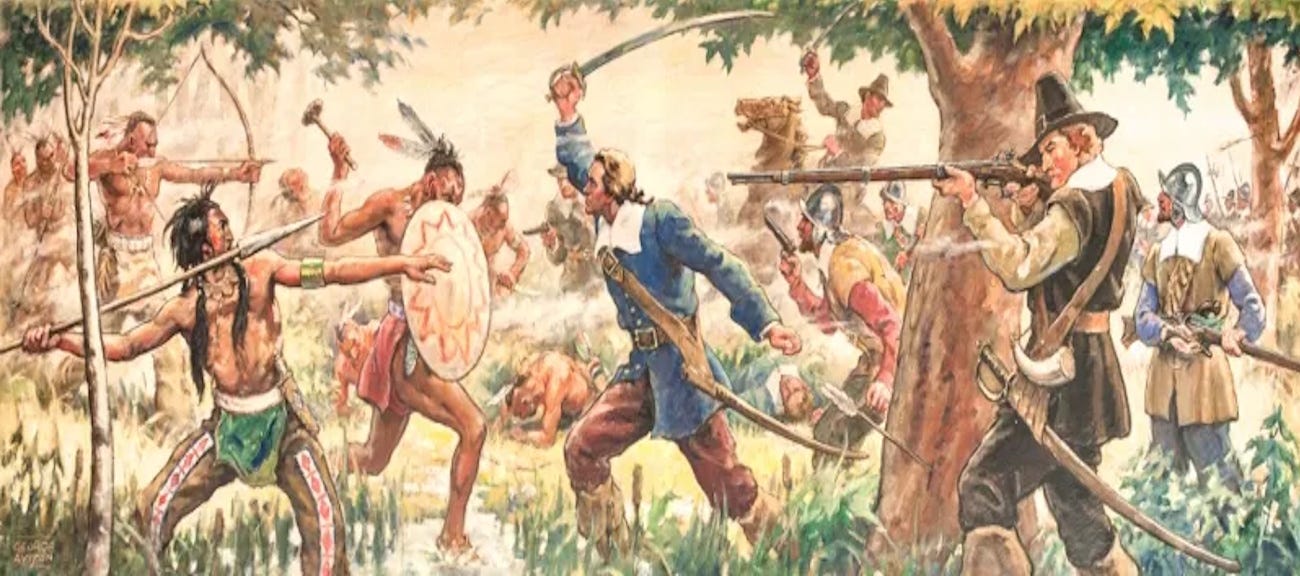
Shortly after Underhill’s return, the English spotted their ships in Long Island Sound sailing west for the Thames River. As the troops retreated west to meet their ships, Pequots attacked them at the base of Pequot Hill. The Pequot rushed headlong down the hill and a furious battle ensued until the Pequot broke off the engagement.
The English allied forces stopped briefly at Fishtown Brook at the base of Pequot Hill to refresh themselves and tend the wounded, before beginning the 8-mile march to the Thames River. Captain Mason marched with the wounded at the head of the column and Captain Underhill served the rear guard while Pequot warriors rained arrow fire at them from cover. As a countermeasure, the English fired volleys into the swamps and thickets where the Indians hid. Underhill and the rear guard faced constant attack from the flanks and rear. Underhill reported more Pequot warriors were killed in these actions than at Mistick Fort. The English lost one killed, and several more wounded during the retreat. Allied casualties are unknown.
The English encountered a small hamlet of several wigwams which they burned, but not before salvaging mats and poles to fashion stretchers for the four or five English wounded who were unable to walk. The Pequot counterattacks inexplicably stopped two miles from Thames River, perhaps because they had lost so many warriors in the counterattacks. The English marched to the top of a hill overlooking the river and saw their vessels at anchor.
Underhill, the wounded English, and some Indian allies went aboard the English ships and sailed to Saybrook Fort. Mason and the remaining English and most of their Indian allies stayed the night on the western shore of the river. The next morning, the force marched 20 miles to the Connecticut River. They arrived in the early evening, stayed the night, and were transported across the river to Saybrook Fort in the morning. Along the way, the force burned several wigwams and captured 10 warriors and eight women. Six of the warriors were executed. Four of the women remained at the fort, and the other four were transported up river to the Connecticut river towns. A dispute arose among the English and Indian allies regarding the disposition of the women which the English resolved by executing them.
Such scorched-earth tactics worked, at least in this instance. In the weeks following the destruction of Mistick Fort, the remaining Pequot villages (estimated at 18-20 communities and 3,500 people) abandoned their territory for fear of additional attacks by the English. Many Pequot sought refuge among the Narragansett (who likely demanded slavery as restitution), Montauk and other Indian tribes in the region. Sassacus and Mononnotto, the remaining sachems, elected to continue the fight against the English and Narragansett. Sassacus reportedly burned Weinshauks before he abandoned Pequot territory to seek allies and support to continue the fight. Sassacus, with five or six sachems and perhaps two hundred men, women, and children, made his way west along the Connecticut coast intending to seek refuge and support from the tribe’s allies and tributaries at Quinnipiac (New Haven) and Sasqua (Fairfield).
Battle of the Northeast
A large group of Pequot warriors under the sachem Mononotto went north to continue the fight against the Narragansett and join with the Wunnashowatuckoogs, a Nipmuc band in east-central Connecticut who were allies and tributaries of the Pequotato. In June of 1637 a major battle took place somewhere in east-central Connecticut between the Pequot/Wunnashowatuckoogs and the Narragansett and their Nipmuc allies/tributaries in one of the few recorded native on native battles of the Pequot War. The Pequot were defeated and Mononotto fled west along the Connecticut coast to join Sassacus at Sasquanikut (Fairfield).
The English organized another campaign against the remaining Pequots in late June. This force consisting of a hundred English soldiers and an unknown number of Native (Narragansett/Mohegan/Montauk) allies embarked from Saybrook Fort. The forces first sailed for Long Island in pursuit of Sassacus. The Montauk, once allies and Pequot tributaries, submitted to English authority and reported Sassacus was at Quinnipiac (New Haven). The English force disembarked at present-day Guilford, and executed three Pequot sachems they captured at a neck of land known today as Sachems Head. The English continued on to Quinnipiac to learn Sassacus escaped to Sasquanikut (Fairfield), home of their allies and tributaries the Sasqua. The English force continued on foot to the Housatonic River, encountering scattered groups of Pequots along the way. After crossing the Housatonic River in their vessels, the English eventually caught up with Sassacus’ group at Sasquanikut where the last major battle of the Pequot War took place (Fairfield Swamp Fight) on July 13-14, 1637 at Munnacommuck Swamp, known today as the Pequot Swamp.
The English force of approximately a hundred English soldiers and Indian allies forded the Mill River, then proceeded southwest along Mill Hill which provided a commanding view of the area to the south and west. At the southwest tip of the hill the English observed the Pequot and their Sasqua allies in a village on the far side of the swamp less than two miles away. The Pequot and Sasqua spotted the English at the same time and fled into the swamp for safety.
Swamp Fight
The English marched to the base of the hill, encircling the swamp which was approximately one-mile in circumference. Following several hours of combat, the English allowed the women and children to surrender with promises to spare their lives. They would be sold into slavery either in the Caribbean or New England colonies. The English force of a hundred soldiers wasn’t sufficient to prevent Pequot warriors from escaping the swamp, so they proceeded to cut the swamp in half to more effectively surround it and contain the remaining warriors inside. What followed was 24 hours of some of the fiercest fighting of the war. It was also one of the only battles where Pequot warriors were reported to use firearms against the English. Hand-to-hand fighting took place throughout the day and night as the English tried to gain entry into the swamp and Pequot warriors attempted to escape. On the morning of July 14, under cover of fog, approximately 60-80 Pequot warriors broke through a section of the English lines and escaped, although many were wounded and killed in the attempt. English accounts of Pequot casualties differ, ranging from seven dead to as many as 60.
Hours before the English reached Munnacommuck Swamp, Sassacus, with six sachems, a few women (which might have included Sassacus’ daughter) and a body guard of 20 warriors fled north up the Housatonic River and west up the Ten Mile River into eastern New York, headed toward Mohawk territory near Albany, New York. The Pequot were discovered by a warband of Mahican (yes, probably those Mohicans) and Mohawk warriors near the “Stone Church” in Dover Plains, New York. Following a brief skirmish, Sassacus’ group made their way to Paquaige in late July (west of Danbury, CT) where they were surprised in their wigwams by the Mohegan and Mohawk. Sassacus was killed immediately and the few Pequot who managed to escape were quickly found and executed. The Mohawk sent their scalps to Agawam (Springfield) and Hartford. The news reached Boston on August 5, 1637, effectively ending all Pequot resistance.
The Pequots were exterminated by their tribal rivals who they had previous subjugated working on concert with English colonists.
The Pequot War ended where it began, on Block Island. On August 1, 1637 Israel Stoughton pursuing refugee bands of Pequot, sailed to Block Island with a small force to seek satisfaction from the Manisses. Stoughton and his men killed several Manisses and burned several wigwams before the Manisses submitted to English authority.
Hartford Treaty
The Treaty of Hartford ratified by the English, Mohegan and Narragansett on September 21, 1638 was the official end to the Pequot War. The treaty stipulated the surviving Pequot, mostly women and children, were to be dispersed among the Mohegan and Narragansett, and no longer called Pequot. The treaty also stipulated the surviving Pequot would never again be allowed to live in their former territory.
Who was at fault for the decimation of the Pequot? All sides, especially the Pequot. Like Massasoit, they could have bargained for peace, and survived. There are approximately 4,000-5,000 Wampanoag still living near Plymouth, Massachusetts today, suggesting peace based on peaceful cooperation could work, but the Pequot already had a policy of aggression and subjugation of the peoples around them. Once they started attacking English settlers, the colonists had no choice but to respond or find themselves wiped out. Before the destruction of the Mistick fort village, the English might have been able to stop fighting and enter into peace negotiation, but the Pequot were uninterested in peace after that. They decided it was a war to the extermination of the other. The English responded accordingly.
Because if someone is seeking to exterminate you, a half-hearted response might delay your extermination for a short while, but it won’t prevent it.
We also need to recognize the Narragansett had some of the same aggressive stances as the Pequot. It was to their interest to rid the region of the Pequot.
As the first major war with the American Indians, the Pequot War settled things…for a while. Following the near-annihilation of the Pequot, the Narragansett and Mohegan tribes (formerly English allies) vied for dominance among the tribes, while colonists continued to expand their territory, increasing friction with Native populations. The competition for controlling the fur and wampum trade, the fuel for the Pequot War, continued to drive disputes between settlers and the Algonquian-speaking tribes. The unfortunate spread of disease among vulnerable tribes allowed for rapid English colonial expansion, reducing the autonomy of indigenous tribes, and heightening the pressures that would finally erupt into King Philip’s War.
In the French Recollects who arrived in Hudson Bay colones there was a non aggression observation and objectification of the language, culture and Faith. The Indian Tribs were thought to be the "Lost Tribe of Israel. The Franciscan Recollects had been only ten years documenting the language in three Tribes when They had to return to France to face Treason charges, for which they were exonerated. When the Recollects had returned to Canada, the Jesuits had replaced them and were doing God work.