Powhatan Wars
It didn't start in peace

This series is on the foundations and Founding Fathers of the United States. Follow this link to the first article in the series.
War wasn’t always inevitable with the Indian tribes. The Pilgrims showed that. Roger Williams did a pretty good job of avoiding it. Unfortunately, some tribes started out as hostile and war was probably inevitable with them.
Such were the Powhatan Wars. The Indians in the Virginia region had interacted with the Spanish 30 years before the Jamestown colony was established. Perhaps there was lingering resentment from those earlier interactions (all white men look alike). Or perhaps the Cavelliers who established the southern colony were more aggressive than the Puritans. But looking at it from our perspective, it appears war with the Powhatan tribes and their allies appears to have been inevitable.
The Anglo–Powhatan Wars were three wars fought between settlers of the colony of Virginia and the Powhatan tribe in the early 17th century. The first war started in 1609 and ended in a peace settlement in 1614. The second war lasted from 1622 to 1632. The third war lasted from 1644 until 1646 and ended when Opechancanough was captured and killed. That third war resulted in a defined boundary between the Native American tribal lands and colonial lands that could only be crossed for official business with a special pass. This situation lasted until 1677 and the Treaty of Middle Plantation which established Indian reservations following Bacon’s Rebellion
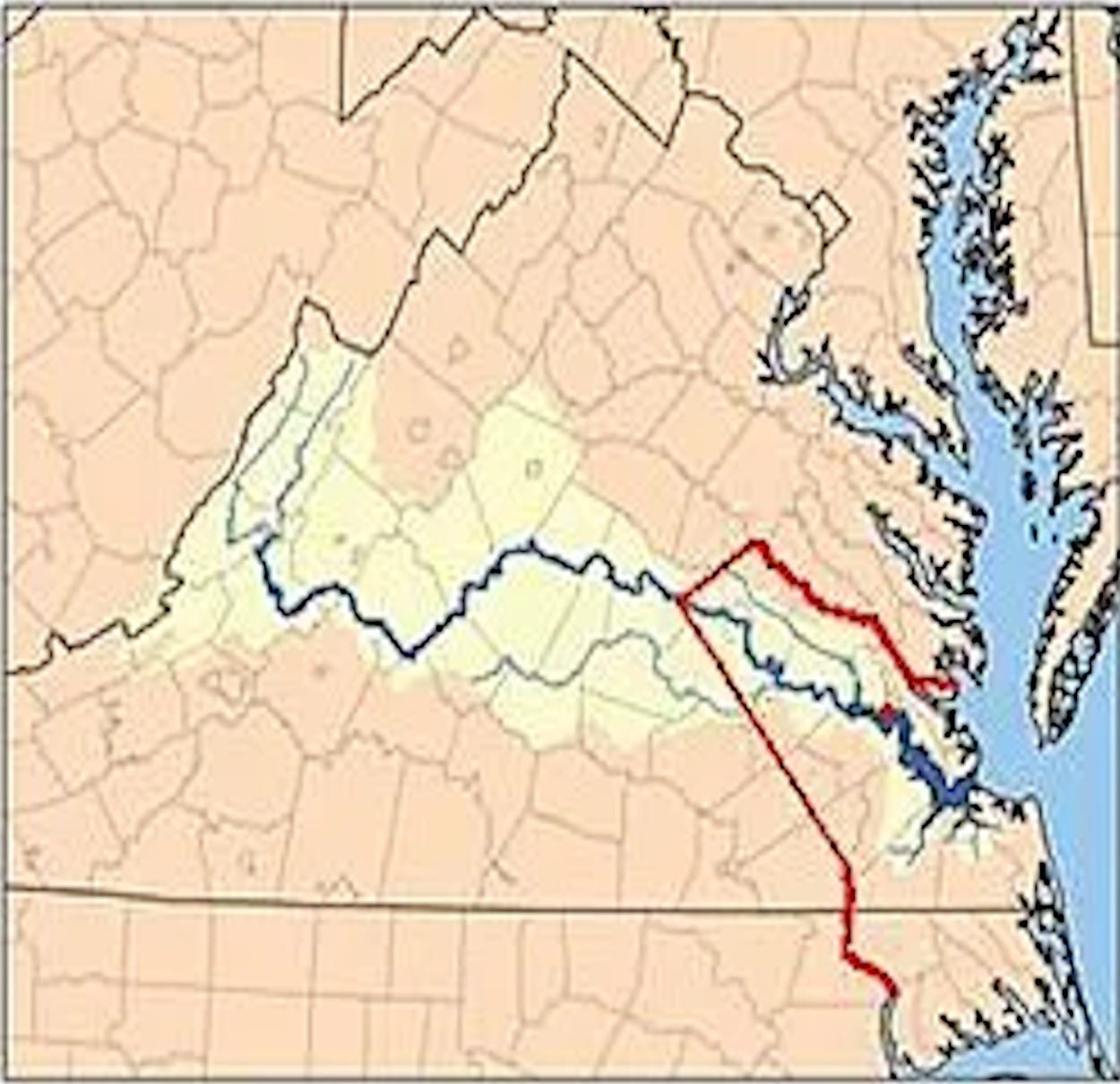
Bound for Conflict
Jamestown, Virginia accidentally established itself within 15 miles of the main village of the Powhatan tribe in May 1607. Within the territory of the Powhatan, who were led by Chief Wahunsunacawh (known to the colonists as Chief Powhatan), the swampy land proved ill-suited to farming, and Powhatan wanted Captain John Smith and the colonists to forsake the swamp and live in one of tribe’s satellite towns called Capahosick where they would make metal tools for him in exchange for full provision.
Yeah, that sounds suspiciously like an offer of enslavement.
Smith underestimated the capabilities of the tribe. The Indians knew the land much better than the colonists. Smith reconnoitered the countryside near Powhatan’s capital of Orapax in December, only seven months after building the fort on Jamestown Island, when a communal hunting party led by Chief Powhatan’s son (or brother, history’s a little shaky here) Opechancanough captured him.
Smith agreed to move the colony to Capahosick and was released in time for New Year’s 1608, having convinced Powhatan he was the son of Captain Christopher Newport and Newport was their head weroance (war chief - similar to a sachem from the northern tribes).
By spring 1609, the local Paspahegh tribe resumed raiding the fort at Jamestown. However, their weroance Wowinchopunk declared an uneasy truce after he was captured. Smith had become president of the colony the preceding fall, and he attempted to establish new forts in the territory that summer. He sent a party with Captain John Martin to settle in Nansemond Country, but Martin abandoned the position after 17 men disobeyed orders and were wiped out while trying to buy corn at the Kecoughtan village. Smith also sent 120 men with Francis West to build a fort upriver at the falls of the James River, right above the main town of Powhatan at present-day Richmond, Virginia. He purchased the site from Powhatan’s son Parahunt, but this ended up faring no better.
Remember, during our discussion of northern tribes, when I explained the colonists thought they were buying exclusive ownership of the land while the tribes thought they were buying a license for conditional use. The southern colonies had the same problem, even with interpreters. It was a fundamental cultural disagreement that made war inevitable.
It seems Smith might have been able to forge a lasting peace. He seems willing to play the sort of ritual games needed to appease tribal culture. But Smith was injured in an accidental gunpowder explosion and sailed to England in October for treatment. He was replaced by people who didn’t have the same diplomacy standards. The settlers established Fort Algernon at Old Point Comfort in the fall of 1609, right beside the Kecoughtan village. In November, Powhatan ambushed and killed Captain John Ratcliffe and 32 other colonists, who had gone to Orapax to buy corn, and a food shortage turned into a famine.
And this was part of the problem. The Indians would sometimes deal honorably with the colonists (selling them food), but then they’d turn around and pillage and kill the same colonists. The colonists didn’t know if it was the same tribe or different tribes. If they survived, they retaliated against the nearest tribe because they didn’t know there were differences.
After being shipwrecked on Bermuda for nearly a year, Thomas Gates finally arrived in late May 1610 with meager and insufficient supplies. Gates saw the state of the colony due to their lack of food, and decided to evacuate Jamestown on June 7. However, on their second day of sailing, they met Francis West’s older brother Thomas West, 3rd Baron De La Warr, coming into the bay equipped with additional colonists, a doctor, food, supplies, and a contingent of 150 armed men. They returned to the fort under De La Warr’s command.
De La Warr proved far harsher and more belligerent toward the Indians than any of his predecessors, engaging in wars of conquest against the tribes, first sending Gates to drive off the Kecoughtans from their village on July 9, then giving Chief Powhatan the ultimatum to either return all colonists and their property or face war. Powhatan responded by insisting the colonists either stay in their fort or leave Virginia. Of course, the colonists couldn’t stay in their fort — their fields were outside. But, De la Warr appears to have had some sociopathic tendencies.
The colonial commander had the hand of a Paspahegh captive cut off and sent him to the Powhatan, demanding the return of all colonists and their property or the neighboring villages would be burned. Chief Powhatan didn’t immediately respond. He might have realized now he was dealing with barbarians and a trait of the Powhatan tribe was to take a pause before attacking with overwhelming viciousness.
De La Warr sent George Percy and James Davis with 70 men to attack the Paspahegh town in August 1610, burning houses and cutting down cornfields. They killed between 15 and 75 villagers and captured one of Wowinchopunk’s wives and her two children. Returning downstream, the colonists threw the children overboard and shot them in the water. Wowinchopunk’s wife was executed in Jamestown. The Paspahegh never recovered from this attack and abandoned their town.
Do you think maybe the Powhatan knew of this barbarity? Of course they did!
It was only a matter of time before they responded.
A party of colonists was ambushed at Appomattoc in the fall of 1610, and De La Warr managed to establish a company of men at the falls of the James River, who stayed there all winter. In February 1611, Wowinchopunk was killed in a skirmish near Jamestown, which his followers avenged a few days later by enticing some colonists out of the fort and killing them. In May, Governor Thomas Dale arrived and began looking for places to establish new settlements. The Nansemond tribe repulsed him, but he successfully took an island in the James from the Arrohattocs, which became the palisaded fort of Henricus. Dale and his men seized the Appomattoc town at the mouth of the James and palisaded off the neck of land, renaming it New Bermudas. The aged Chief Powhatan made no major response to this colonial expansion, possibly because he was losing effective control to his younger brother Opechancanough during this time. This allowed the colonists to strengthened their positions.
In December 1612, Captain Samuel Argall concluded peace with the Patawomeck, and he captured Powhatan’s daughter Pocahontas. This caused an immediate ceasefire from the Powhatan raids on the colonists, as they ransomed her for peace. In the meantime, settlers began expanding south of the river.
The Powhatans had lost much of their riverfront property along the James; the Kicoughtan and Paspehegh tribes had been effectively destroyed, and the settlers had made major inroads among the lands of the Weyanoke, Appomattoc, Arrohattoc, and Powhatan. The Arrohattoc and Quiockohannock tribes disappear from the historical records after this, possibly indicating they had been dispersed or merged with other tribes.
I’m sure those that survived wanted some payback.
Peace of Pocahontas
Peace negotiations stalled over the return of captured hostages and arms for nearly a year. Dale took Pocahontas and a large armed force to find Powhatan in March 1614. They were showered with arrows at present-day West Point, so they went ashore and sacked the town. They finally found Powhatan at his new capital in Matchcot, and they concluded a peace sealed by the marriage of Pocahontas to colonist John Rolfe. Rolfe and Pocahontas married April 16, 1614 and had their only son eight months later, so this might not have been a marriage of contract. This was the first known interracial union in Virginia and helped to bring a brief period of better relations between the Indians and the colonists.
A separate peace was concluded the same year with the Chickahominy tribe which made tribal members honorary “Englishmen” and thus subjects of King James I. This period of peace is sometimes called the peace of Pocahontas.
Second Anglo-Powhatan War
As we saw with the Wampanoag, peace treaties might last during the lifetime of the signatories…maybe.
By 1622, Powhatan and Pocahontas had both died, and the English had spread deep into Powhatan territory. The English forced the Powhatan Indians to move inland away from their traditional river valley homes. Native leaders under Powhatan’s half-brother and successor, Opechancanough, adopted a more militant attitude toward the English.
Opechancanough maintained a friendly face to the colony and even met with a Christian minister to give the appearance of his imminent conversion to Christianity. Then, his warriors struck without warning on March 22, 1622, from where they had been planted among the settlements, and killed hundreds in the Indian massacre of 1622. A third of the colony was wiped out in a day, and a higher toll would have been taken without last-minute warnings by Christian Indians.
Thanks to two Indian boys who acted as interpreters, Jamestown was warned and escaped destruction. Colonists from outlying areas were ordered into fortified settlements, where severe food shortages occurred and contagious diseases spread. The settlers retaliated, burning Powhatan villages, taking their corn and killing the inhabitants.
Powhatan war practice was to wait and see what would happen after such a blow was inflicted in the hope the settlers would simply abandon their homesteads and move elsewhere. However, English military doctrine called for a strong response, and the colonial militia marched out nearly every summer for the next 10 years and made assaults on Powhatan settlements. The Accomac and Patawomeck were allied with the settlers and provided them corn while the colonists went to plunder villages and cornfields of the Chickahominy, Nansemond, Warraskoyack, Weyanoke, and Pamunkey in 1622.
Opechancanough sued for peace in 1623. The colonists arranged to meet the Indians for a peace agreement but poisoned their wine, fell upon them, shot and killed many in revenge for the massacre. The settlers then attacked the Chickahominy, the Appomattocs, Nansemond, and Weyanokes.
Yeah, they were backstabbers! But so were the tribes.
No one was right in any of this!
In 1624, the Powhatans assembled 800 bowmen led by Opechancanough’s younger brother Opitchapam, arrayed against just 60 colonists. The settlers destroyed the Powhatans’ cornfields, and the bowmen gave up the fight and retreated. A shortage of gunpowder in the colony delayed the colonists from follow-up marches in 1625 and 1626. The Indians seemed unaware of the shortage while they also desperately tried to regroup. Summer of 1627 brought renewed assaults against the Chickahominy, Appamattoc, Powhatan proper, Warraskoyak, Weyanoke, and Nansemond.
A peace was declared in 1628, but it was more like a temporary ceasefire since hostilities resumed in March 1629 and continued until a final peace was made on September 30, 1632. The colonists began to expand their settlements on the eastern shore and both sides of the James, as well as south of the York, and they palisaded off the peninsula between the York and James at about Williamsburg in 1633. By 1640, they began claiming land north of the York, and Opechancanough leased some land on the Piankatank to settlers in 1642 for the price of 50 bushels of corn per year.
Which sounds like a whole lot better solution than massacreing people
By 1634, a 6-mile palisade was completed across the Virginia Peninsula, providing some security from attacks by the Indian tribes and allowing colonists to farm and fish in relative safety.
Third Anglo-Powhatan War
Twelve years of peace followed the Indian Wars of 1622–1632. In April 1644, the remnants of the Powhatan Confederacy under Opechancanough resumed their assaults, killing several hundred colonists in an attempt to drive out the settlers from the Virginia Colony.
The colonists had been there for a generation, but the Indians still wouldn’t accept their presence.
In 1645, the colony ordered the construction of three frontier forts: Fort Charles at the falls of the James, Fort James on the Chickahominy, and Fort Royal at the falls of the York. The next year, the colony built Fort Henry at the falls of the Appomattox River. In August 1646, Governor William Berkeley stormed the village where Opechancanough resided and captured him. All captured males in the village older than 11 were deported to Tangier Island. Opechancanough was taken to Jamestown and imprisoned. Very old and infirm, unable to even move without assistance, Opechancanough died in captivity in October 1646, killed by a settler assigned to guard him, who maybe had lost people in the attack the year before. By this time Necotowance had succeeded him as the last chief of the Powhatan Confederacy.
In October 1646 the General Assembly of Virginia signed a peace treaty with Necotowance which brought the Third Anglo-Powhatan War to an end. In the treaty, the tribes of the confederacy became tributaries to the King of England, paying a yearly fee to the Virginia governor. At the same time, a frontier was delineated between Indian and colonial settlements, with members of each group forbidden to cross to the other side except by a special pass obtained at one of the border forts. The extent of the Virginia Colony open to patent was defined as the land between the Blackwater and York rivers, and up to the navigable point of each of the major rivers. The treaty also permitted settlements on the peninsula north of the York and below the Poropotank, where settlers had been since 1640.
Aftermath
Necotowance remained paramount chief of what was left of the Powhatan Confederacy until his death about 1649. The tribes of the former confederacy scattered. When Totopotomoi succeeded Necotowance, he was chief of the Pamunkey, not paramount chief of the Powhatan. Furthermore, Totopotomoi worked as an ally with the colonial government to maintain peace. In 1656 he died in the Battle of Bloody Run fighting on the side of the colonists against encroaching hostile tribes. His wife Cockacoeske succeeded him. This period of time is often referred to as a time of relative peace between the colonists and the tribes but it also saw the constant encroachment upon the lands designated to the Indians in the treaty of 1646.
Chief Wahanganoche of the Patawomeck tried to work with the colonists, deeding them tribal lands, but his consolation backfired. In 1662, colonists accused Wahanganoche of murder. Found innocent of all charges by a specially convened session of the House of Burgesses, Wahanganoche was nevertheless murdered by colonists while attempting to return home from his trial. Shortly thereafter the colonial government demanded all Patawomeck ‘sell’ their land and in 1666 declared war on the Patawomeck, calling for their “extirpation”.
The tribes of the Northern Neck of Virginia were effectively wiped out, and the few who escaped were absorbed into other remaining tribes in the region. The peace was shattered further when a small group of Doeg Indians murdered two settlers known for mistreating and defrauding natives, and pillaged the general area.
This caused a series of escalations and confusions which culminated in Bacon’s Rebellion in 1676. This resulted in the Treaty of Middle Plantation signed by Cockacoeske who rallied together other local tribes to sign too. The treaty set up reservations for each tribe and allowed them hunting rights outside their reservations. It established all the Indian rulers were equal, with the provision that Cockacoeske was owed the subjection of several scattered groups of Indians.
Cockacoeske was apparently more equal than other chiefs.
Analysis
While the Northern colonies started in peace before rival Europeans encouraged tribal jealousies to attack other European groups, the English of the Southern colonies quickly fell into extermination of tribes. Under John Smith, there was an attempt to establish peaceful terms, but subsequent leaders seem to have assumed their superiority to the tribal leaders and to have not thought twice about wiping out the tribes.
I can’t help think this was largely due to the Southern colonies being run by the younger brothers of English aristocats, assured of their wonderfulness because of their exalted status in England. Meanwhile in the North, the leaders were often merchants or ministers who might not like or might even fear Indians, but were guided by a higher power. It didn’t stop either of them from, eventually, killing Indians, but it did take the New England colonies a bit longer to get started.
So many opportunities for peaceful coexistance were cast aside by both sides. The Indians were no more innocent in their ways than the English. They were all so very human and that humanity killed a lot of people.