Pumping Cold Air
When technology falls short

Heat pumps are touted as the latest emerging technology to thwart climate change, so you can be forgiven if you don’t know that they’ve been around for a long time. The technology’s boosters claim they’re much more energy-efficient than traditional heating and cooling systems and will almost always reduce your household’s carbon emissions, probably by a substantial proportion, especially if they run on “clean” sources of electricity.
They must be that good, because Joe Biden authorized the use of the Defense Product Act to “rapidly expand American manufacturing of…critical clean energy technologies,” including heat pumps. And, of course, Joe Biden never does anything that appears ill-thought-out or that will cost the American people more money to live.
Of course, he wouldn’t.
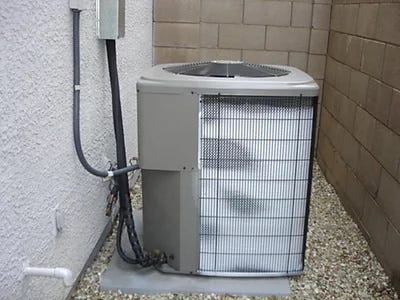
Understanding Heat Pumps
My husband was a heating technician before he got his journeyman electrician’s license, so I’ve had about 30 years of experience with Alaska heating systems. I can even do very basic heating repair myself.
The mechanic’s wife’s car is always broken, but heating your home in Alaska is not an optional activity.
A heat pump, either air- or ground-source, contains four main parts – a cold source heat exchanger called the evaporator, a compressor, a high-temperature heat exchanger called the condenser, and an expansion valve. The system is filled with a working liquid like a refrigerant, although I do know people who use water in the ground-source heat pump they use to COOL their home in the summer.
Heat is absorbed in the evaporator, which vaporizes the refrigerant. This vapor is then compressed, raising its temperature and pressure. Then now hot refrigerant vapor is piped to the condenser where its heat is removed and used for heating. During this heat transfer process, the refrigerant condenses back to liquid. This liquid passes through the expansion valve to the low-pressure side of the system. Then the cycle repeats.
The efficiency of a heat pump is called its Coefficient of Performance (COP). This is the ratio of heat output to work input. A heat pump operating at a COP of 5 will produce 5 KWH of heat for every 1KWH of electricity supplied.
The COP is largely dependent on the temperature difference between the source and the sink. The greater the difference, the lower the COP. A heat pump operating between a ground or air temperature of 45’F and an inside temperature of 70’F has a much higher COP than the same system operating between 0’F and an inside temperature of 70’F. Typical COPs for heat pumps tend to be in the 1.5 to 6 range.
Heat pumps are classified as either air-source or ground-source. There’s also a hybrid system that uses both air- and ground-source. Air-source heat pumps extract heat from the ambient air. Therefore, COP shows one of the main disadvantages of air-source heat pumps in Alaska. We need our houses to be between 65 and 70 degrees most of the winter, but the outside temperature is sub-zero for four or five months a year. Therefore, peak heating demands coincide with the unit’s lowest COP. Heat is most expensive when it is needed most. Despite this, the industry has developed air-source heat pumps suitable for use down to 0’F.
I suspect one month of extremely high electric bills won’t bankrupt most people, but Alaska doesn’t have a one-month winter. Ours is 4-5 months long.
Alaskans don’t generally consider 0’F to be cold, although we do need to heat our homes from freezing, which is 37 degrees warmer than that. The reason we don’t consider 0’F to be cold is that our outside winter temperatures tend to be much colder than that. That doesn’t mean 0’F isn’t dangerous to human life.
Thus, air-source heat exchangers are rendered useless for about one-half of our winter. And while air-source heat pumps will work from freezing to 0’F, they tend to use a lot of electricity, thereby making them spendy for another third of the winter. They don’t work at all in December-February and they need supplementation from another heating source in the shoulder seasons of October-November and March-April to put your house in the comfortable zone.
Air-source heat exchangers can work with supplementation in the relatively temperate rainforests of our Southeast area (which coincidentally has cheap hydroelectric), but most of the mainland of Alaska is much colder than Juneau.
Ground-source heat pumps have been used since the late 1940s and they have several configurations, including open loops that pump water directly from a well or body of water. Since our lakes actually entirely freeze in the winter, lake loops are unknown here, but you do see ground-well heat pumps.
Something you probably have never heard of because it’s really that nerdy is that the ground can only go down to -18’F. Do not ask me to explain this scientific marvel. I trust the hydrologists and geologists who told me that the coldest the ground beneath us gets even in permafrost is -18’F. That is 45 degrees colder than freezing. So while my outdoor air today is somewhere in the -30’ range, the ground beneath my feet is probably -18’F and won’t get any colder.
This geological oddity allows a ground-source heat pump to operate with a higher COP in colder weather than an air-source heat pump. Ground-source heat pumps are therefore more appropriate for Alaskan use. Still, the highest COP is still when the difference between the ground temperature and the indoor temperature is lowest. The colder the ground, the less efficient the system.
My tap water comes out at 35’F. If it weren’t under pressure, it would be slush.
I have friends who heat their homes with ground-source heat pumps with woodstove supplementation. This time of year, they are heating their homes with woodstoves using their heat pumps as the backup.
Getting Geeky
Out of curiosity, I checked with a heat pump calculator recommended by the State of Alaska’s Energy Department. It would cost $10,000 to install this equipment. Over the estimated 14-year lifetime of the equipment, my return on investment would be $350. That’s a cost of $714 a year minus $25 ROI. My annual fuel savings would be 257 gallons of my approximate 700 gallons of diesel. But while the 700 gallons heats my entire home, the ground-source heat pump will serve only 37% of the building’s space heating load. Meanwhile the annual increase in electricity use will be 3,646 KWH.
So my electric bill would increase to about $350.00 a month while my fuel bill wouldn’t decrease at all because I still have to heat 100% of my home and if the heat pump is only heating one-third of it, then I have to heat the rest of it, so I can assume I’ll still burn 600 gallons of fuel in a winter. So I save $275 to spend an additional $760 on electricity…and that’s not even counting the cost of the heat pump itself, which factors to $691 a year.
According to the provided chart, the only months when I could heat my home entirely with the heat pump are June, July and August (when I don’t heat my home at all now). The heat pump could take the majority of the load in April, September and October, when my traditional heating system barely comes on because the thermostat is set at 60 degrees except for about 15 minutes in the morning to take the chill off the house.
The Northeastern Energy Efficiency Partnership says the key feature of a “cold-climate heat pump” is a variable speed compressor, powered by an inverter. They believe this type of compressor will meet the needs of regions with big seasonable swings, which a variable-speed system will hold a steadier temperature than a traditional single-speed HVAC system. Of course, the mechanical engineers they’re consulting are so ignorant of other places in the country that they don’t realize that latitutudes with real winter use hydronic systems rather than forced air systems. And they apparently don’t know that compressors in general freeze at about -20’F. I have one I use to inflate tires and operate some tools and it must live inside my house because it won’t work if it’s in the unheated garage.
This is why those who have tried heat pumps in Alaska generally don’t use air-source heat pumps. Ground-source is much more expensive to install, but these systems work a lot better in our climatic conditions.
They just don’t work all that well.
Geographical Science
My advisor on Twitter/X seemed to think I had old information that just needed to be corrected.
“Just get an energy audit and they’ll set you right.”
Energy audits, by the way, cost several hundred dollars. How do I know that? I just paid for one last fall. I figured it was time since I was popping to replace my boiler. We ended up adding insulation to the outside of my foundation and bolstering the insulation in the attic. We discussed all the heating options available before I opted to hire a former coworker of my husband to replace my failing 30-year-old oil-fired boiler with a high-efficiency oil-fired unit that has the potential to be switched to natural gas if the fuel ever becomes readily-available and cost-effective in Fairbanks.
In reading through various articles about heat-pump use in cold weather, I kept running across the suggestion that you can combine a heat pump with electric-resistance baseboards…so you’re never cold.
I laugh at your suggestion and replace it with a reality of my own.
Nobody uses electric resistance baseboards in Fairbanks these days, but there was a brief window of time when they were all the rage. Back when the adults would get all excited about the prospect of a natural gas pipeline coming down from the Slope, they were also really excited about a hydroelectric dam on the Yukon River at Rampart or the Susitna River north of Anchorage. It would have made a lot of sense to have cheap electricity generated by abundant hydro (like in Canada) or natural gas (like in Anchorage). Thanks to environmental activists and the high cost of construction in very rural areas, these projects were never built, leaving a bunch of newer houses heated with electric-resistance baseboards. Golden Valley Electric Association rates have always been high and those all electic houses had enormous bills. All those houses switched over to diesel in the 1970s. My brother’s house was one of those. His first-winter monthly electric bill was twice, and one month nearly triple, his mortgage payment. He installed an oil-fired hydronic boiler as soon as he could do so.
So a heat pump will increase my electric costs by 60% and reduce my diesel costs by 10% (although I suspect the diesel furnace will run all the time to make up for the 60% of the house the heat pump promises not to heat). It’s likely to need a lot of maintenance because the compressor will freeze every winter. The five people I know who have air-conditioning (which are essentially air-source heat pumps) say their systems require repair every year. Which means these systems are likely to go down in the winter when you need them the most.
Air-source heat pumps are heralded as key to a low-carbon future, reducing our reliance on carbon fuels. They work great in weather that Alaskans consider “fall-ish”. But they’re not the panacea their boosters insist they are.
Ground-source heat pumps are much more costly to install, but work better in our environment. I know people here who have GSHPs with wood stoves as backup. For most of the winter, they burn wood continuousely to make up for the shortfall in the heat from the GSHP.
Where you live makes a great deal of difference in what your heating needs are and in what technologies will meet those needs.
The ideologically-based hatred of fossil fuels makes it impossible for some people to see reason on the subject. That’s fine…you do you…until you start mandating that I do what you think is best, whether it makes sense for me or not.
Lela Markham is an Alaska-based novelist and commentator who doesn’t live in a warm climate and therefore sees things a bit differently.
Good to read something from someone with real experience. I don't know how many "get a heat pump and save the planet" arguments I have participated in.
Now if one's house was close enough to say Chena or Manley Hot springs here in Alaska, a water or ground based heat pump could work just fine. However old fashioned radiators, pipes and ifnecessary, pumps, would work better and cheaper.