Queen Ann's War

This is series is on the foundations and Founding Fathers of the United States. Follow this link to the first article in the series.
Queen Anne’s War (1702–1713) was the second in a series of French and Indian Wars fought in North America involving the colonial empires of Great Britain, France, and Spain; it took place during the reign of Anne, Queen of Great Britain, who was the Protestant daughter of Catholic James II, and the sister of Mary of William and Mary. In the United States, Queen Ann’s War is regarded as a standalone conflict, but it was really part of the War of Spanish succession. It is also referred to as the Third Indian War, but in reality, it was simply a wider version of King William’s War, though the outside influences were different.
Historical Context
When the last Habsburg monarch, Charles II, died in 1701, European powers disputed the succession. What started as a small conflict centered around Habsburg holdings widened in May 1702 when England declared war on Spain and France. Both the England and France wanted to keep their American colonies neutral, but they didn’t reach an agreement. It might not have mattered since the American colonists had their own tensions which had been growing along the borders separating the French and English colonies. Nothing was really settled by King William’s War and the conflicts concerned boundaries and governing authority in the northern and southwestern frontiers of the English colonies, which stretched from the Carolinas in the south to the Massachusetts Bay Colony in the north, with additional colonial settlements or trading outposts on Newfoundland and at Hudson Bay.
The total population of the English colonies was about a quarter-million with Virginia and New England dominating. The colonists concentrated along the coast, with small settlements inland, sometimes reaching as far as the Appalachian Mountains. Colonists knew little of the interior of the continent to the west of the Appalachians and south of the Great Lakes, a region dominated by numerous Indian tribes, though visited by French and English traders. Spanish missionaries in La Florida established a network of missions in an effort to convert the Indians to Roman Catholicism and coopt their labor. About 1500 Spanish population ministered to an Indian population of around 20,000.
When French explorers located the mouth of the Mississippi River, they established a small colonial presence at Fort Maurepas near Biloxi, Mississippi, in 1699. They built trade routes into the interior, establishing friendly relations with the Choctaw, a large tribe whose enemies included the English-allied Chickasaw. The tribes suffered greatly from infectious diseases accidentally introduced into the Americas, but they liked European trade goods.
The arrival of French colonists in the south threatened existing trade links established by Carolina colonists creating tension among all three powers. France and Spain, allies in this conflict, had been on opposite sides of the recently ended Nine Years’ War. Conflicting territorial claims between Carolina and Florida south of the Savannah River mixed with animosity over religious divisions between the Roman Catholic colonists of New Spain and the Protestant English colonists along the coast.
To the north, the conflict held a strong economic component in addition to territorial disputes. Newfoundland was the site of a British colony at St. John’s and a French colony at Plaisance, with both sides also holding a number of smaller permanent settlements, along with many seasonal settlements used by European fishermen from Europe. These colonists numbered fewer than 2,000 English and 1,000 French permanent settlers (many more seasonal visitors), who competed for the fisheries of the Grand Banks alongside the fishermen from Acadia (consisting of Nova Scotia and New Brunswick), and Massachusetts.
The borders between Acadia and New England remained uncertain despite King William’s War. New France defined the border of Acadia as the Kennebec River in southern Maine. There were Catholic missions at Norridgewock and Penobscot, which was probably terrifyingly close for Protestants whose parents had been persecuted by Mary Tudor. The frontier areas between the Saint Lawrence River and the primarily coastal settlements of Massachusetts and New York were still dominated by Indian tribes, primarily Abenaki in the east and Iroquois west of the Hudson River. Remember what I said about the Iroquois being genocidal maniacs.
The Hudson River–Lake Champlain corridor had served as a raiding trail for both sides in earlier conflicts. Reductions in Indian population due to disease and King William’s War had reduced some of the tribal threats, but the Iroquois were still actively massacreing their neighbors.
The Hudson Bay territories (Prince Rupert’s Land) had been roiled between English and French commercial companies in the 1680s, but the 1697 Treaty of Ryswick left France in control of all but one outpost on the bay. Both sides largely adhered to the treaty, but when the French attacked Fort Albany in 1709, it provided the pretext for the Hudson’s Bay Company to successfully demand return of their territories at the end of the war.
War!
Prominent French and English colonists understood control of the Mississippi River would have a significant role in future trade and settlement. Each developed plans to thwart the other’s activities. French Canadian explorer Pierre Le Moyne d’Iberville called for establishing relationships with tribes in the Mississippi watershed, then leveraging those relationships to push the English colonists off the continent. This is where his relationship to the Choctaw came in.
English colonial traders and explorers from Carolina had established a substantial trading network across the southeastern part of the continent extending to the Mississippi. Colonial leaders had little respect for the Spanish in Florida, but they recognized the threat posed by the French arrival on the coast. Carolina governors Joseph Blake and James Moore both articulated visions of expansion to the south and west to thwart French and Spanish expansion.
The Spanish planned to arm the Apalachee warriors and send them against the English colonists and their allies, but the English colonists caught wind of a back country invasion and organized a successful defense at the head of the Flint River.
Carolina’s Governor Moore received notification of the attack and led 500 English colonists and 300 Indian forces against Spanish Florida, burning St. Augustine, Florida in 1702. Unable to break the main fortress, the English withdrew when a Spanish fleet arrived from Havana. Moore deciminated the Apalachee and Timucua of Spanish Florida in a 1704 a raiding expedition by Moore. Many of the survivors of these raids were relocated to the Savannah River where they were confined to reservations, though large Indian forces largely absent European control continued throughout the war. In 1706, Carolina successfully repulsed an attack on Charles Town by a combined Spanish and French amphibious force sent from Havana.
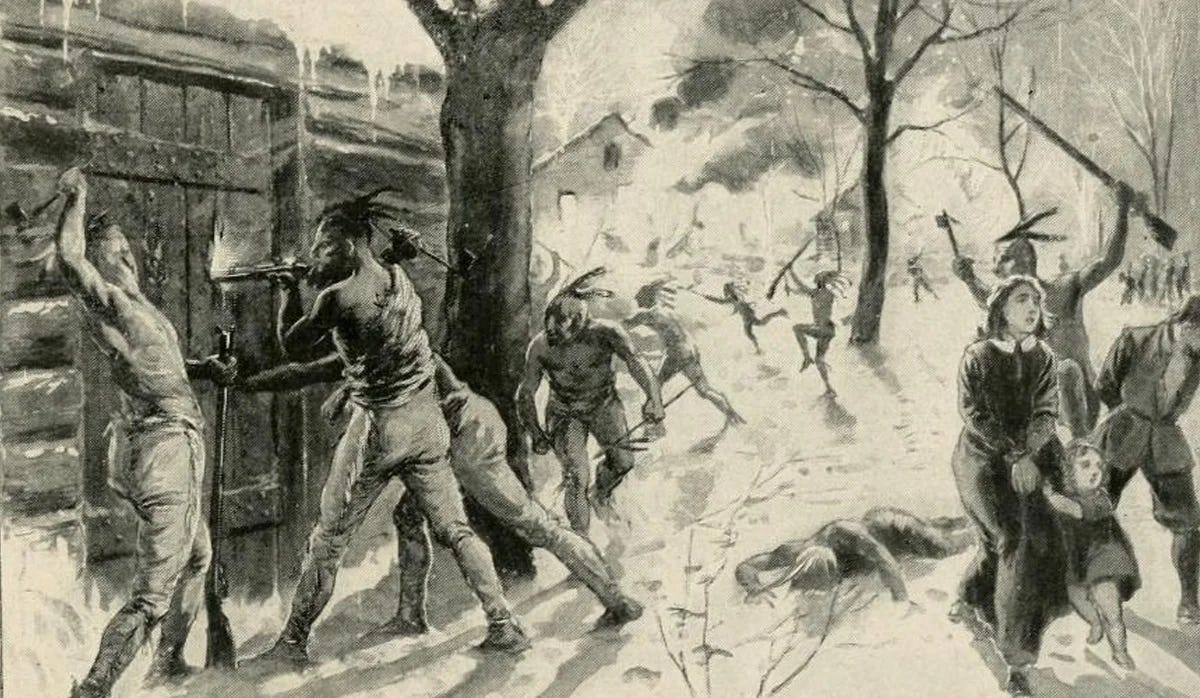
Meanwhile, New France and the Wabanaki Confederacy thwarted New England expansion into Acadia, whose border New France defined as the Kennebec River in southern Maine. In 1703, a handful of French Canadians commanding 500 Indians atacked New England settlements near Falmouth (Portland, Maine), killing and capturing more than 300 English settlers. There was active trade in captives and New England families and communities struggled to raise ransoms to reclaim them. Minister John Williams tried for years without success to ransom his daughter Eunice, who became fully assimilated, marrying a Mohawk man. On the other hand, Ashur Rice was returned to Marlborough after he was ransomed in 1708 by his father Thomas Rice.
Unable to effectively combat these raids, New England colonists retaliated by launching an expedition against Grand Pre, Chignecto (Acadia) led by the famous indigenous fighter Benjamin Church. French accounts claim Church attempted an attack on Acadia’s capital of Port Royal, but Church (who would later become famous during the French and Indian war) described a war council that decided against attacking Port Royal.
Meanwhile, French and Wabanaki Confederacy continued raiding in northern Massachusetts in 1705. The raids happened too quickly for defensive forces to organize, and reprisal raids usually found empty tribal camps. There was a lull in the raiding while leaders from New France and New England negotiated the exchange of prisoners, with only limited success. The Indian raids persisted until the end of the war, sometimes with French participation.
In May 1707, Governor Dudley organized an expedition to take Port Royal, but 1,600 men failed to take the fort by siege, and a follow-up expedition in August was also repulsed. In response, the French developed an ambitious plan to raid most of the New Hampshire settlements on the Piscataqua River, but their Indian allies failed to show up, so the French raided the Massachusetts town of Haverhill. In 1709, New France governor reported two-thirds of the fields north of Boston lay fallow because of French and Indian raids. French–Indian war parties returned without prisoners because the New England colonists stayed in their forts.
In October 1710, 3,600 British and colonial forces finally captured Port Royal after a week-long siege, ending official French control of the peninsular portion of Acadia (mainland Nova Scotia), although resistance continued until the end of the war. The remainder of Acadia (eastern Maine and New Brunswick) remained disputed territory between New England and New France.
The French in New France’s heartland of Canada opposed attacking the Province of New York. They were reluctant to arouse the genocidal Iroquois. They wisely feared them more than they did the British colonists. New York merchants opposed to attacking New France because it would interrupt the lucrative Indian fur trade. The Iroquois, busily grabbing land from opposing tribes, maintained their neutrality throughout the conflict.
New England’s Francis Nicholson and Samuel Vetch organized an ambitious assault against New France in 1709, with some financial and logistical support from the queen. The plan involved an overland assault on Montreal via Lake Champlain and a sea-based assault by naval forces against Quebec. The land expedition reached the southern end of Lake Champlain, but it was called off when the promised naval support never materialized for the attack on Quebec. The Iroquois made vague promises of support for this effort, but successfully delayed sending support until it seemed clear the expedition would fail.
After this failure, Nicholson and Peter Schuyler traveled to London accompanied by King Hendrick and other sachems (war chiefs) to arouse interest in the North American frontier war. The Indians caused a sensation in London, and Queen Anne granted them an audience. Nicholson and Schuyler successful gained the queen’s support for capture of Port Royal in 1710. With that success under his belt, Nicholson again returned to England and gained support for a renewed attempt on Quebec in 1711. This failed disasterously, probably because the Iroquois provided several hundred warriors to fight alongside the English colonists while simultaneously warning the French they were coming.
Meanwhile, Newfoundland’s coast was dotted with small French and English communities, mostly fishing stations occupied by European fishermen. Both sides were dug in at their principal town (French at Plaisance on the west side of Avalon Peninsula and the English at St. John’s. During King William’s War, the French destroyed most of the English communities, and the English fleet finally retaliated for that in 1702, descending upon outlying French communities but making no attempts on Plaisance. Of course the French retaliated, destroying several English settlements and unsuccessfully besieging Fort William at St. John’s. They eventually captured Fort William in 1708, but were unable to hold it, so the English retook it.
Peace?
In 1712, Britain and France declared an armistice in 1712, and signed a formal peace agreement the following year. Under terms of the 1713 Peace of Utrecht, Britain gained Acadia (which they renamed Nova Scotia), sovereignty over Newfoundland, the Hudson Bay region, and the Caribbean island of St. Kitts. France recognized British suzerainty over the Iroquois and agreed commerce with Indian tribes farther inland would be open to all nations. It retained all of the islands in the Gulf of Saint Lawrence and fishing rights in the area.
By the later years of the war, many Abenakis had tired of the conflict despite French pressures to continue raids against New England targets. The peace of Utrecht ignored Indian interests, and some Abenaki expressed willingness to negotiate a peace with the New Englanders. Governor Dudley organized a major peace conference at Portsmouth, New Hampshire , where the Abenakis objected to British assertions France ceded the territory of eastern Maine and New Brunswick, but they agreed to a confirmation of boundaries at the Kennebec River and the establishment of government-run trading posts in their territory. The 1713 Treaty of Portsmouth between New England and the Wabanaki Confederacy included language asserting British sovereignty over Wabanaki territory.
The loss of Newfoundland and Acadia restricted the French presence on the Atlantic, but their continued presence resulted in ongoing friction between French and English fishing interests that weren’t fully resolved until the late 18th century. The economic effects of the war were severe in Newfoundland. The British capture of Acadia had long-term consequences for the Acadians and Mi’kmaq living there. British relations with the Mi’kmaq tribe after the war developed in the context of British expansion in Nova Scotia and along the Maine coast, where New Englanders began moving into Abenaki lands, often in violation of previous treaties. Neither the Abenakis nor the Mi’kmaq were recognized in the Peace of Utrecht, and the 1713 Portsmouth treaty was interpreted differently by them than by the New England signatories, so the Mi’kmaq and Abenakis resisted these incursions into their lands. This conflict was increased by French intriguers such as Sébastien Rale, and eventually they developed into Father Rale’s War (1722–1727).
The French didn’t fully comply with the commerce provisions of the Peace of Utrecht. They attempted to prevent English trade with Indian communities, and they erected Fort Niagara in Iroquois territory. French settlements continued to grow on the Gulf Coast, with the settlement of New Orleans in 1718 and other (unsuccessful) attempts to expand into Spanish-controlled Texas and Florida. French trading networks penetrated the continent along the waterways feeding the Gulf of Mexico, renewing conflicts with both the British and the Spanish. Trading networks established in the Mississippi River watershed, including the Ohio River valley, also brought the French into more conflict with British trading networks as colonial settlements crossed the Appalachian Mountains. Conflicting claims over that territory eventually led to the French and Indian War.
Legacy
Queen Anne’s War, which lasted for 11 years, is a characteristic example of a “war for empire” driven by European state interests. It wasn’t about “liberty” or “voluntary trade.” It wasn’t even about colonial activities in the America’s. It was all about state-sponsored mercantilist competition between Britain, France, and Spain, who each wanted to expand their territorial control in order to increase tax bases, and dominate global trade routes. The average colonist didn’t matter.
The war resulted in a British victory and territory gains, but those “gains” came at a high cost of life, property, and economic disruption for colonists drawn into a conflict primarily over European ruling succession.
The war highlighted the destructive nature of mercantilism. Colonies were mere pawns in a global economic game. The competition for the fur trade and control of the Caribbean resulted in war rather than free commerce.
We really shouldn’t be surprised by that. “War is the health of the state” (Randolph Bourne), the primary mechanism for the growth of government. Queen Ann’s war brought increased military control, higher taxation, and the use of mercenaries (mostly Native American tribes). Brutal,, localized, and often futile, raids on civilian settlements characterized the conflict, causing immense suffering for individuals in the frontier regions.
It was a pointless war achieving nothing for the common people, but allowed European empires to tighten their grips on North America.