Rabble-Rouser with Restraint
Samuel Adams

This series is on the foundations and Founding Fathers of the United States. Follow this link to the first article in the series.
Born as the son of a church deacon in 1722, Samuel Adams understood from a young age the authority private citizens could hold over politics once properly mobilized. Adams acquired something of a historical reputation—in his own time as well as in posterity—as a rabble-rouser and propagandist for the independence movement, especially in comparison to his second cousin John, the future president.
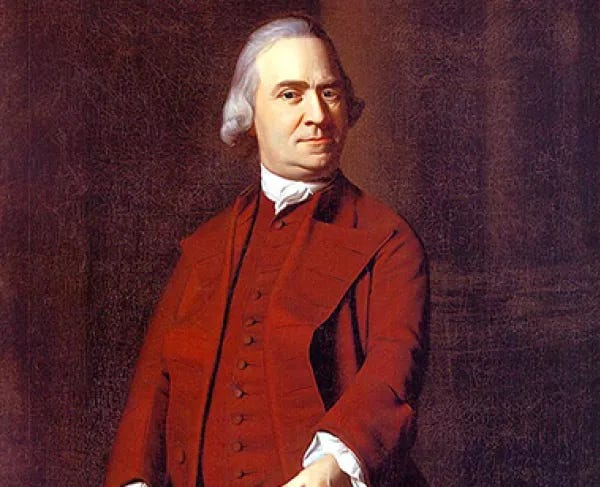
Those accusations tend to obscure his nature as an astute political thinker and a tireless activist. Adams’ father, also named Samuel, frequently used his position as preacher to organize large numbers of associates into groups to lobby local Boston politicians and officials on specific issues, with young Sam frequently accompanying him. At the age of 14, Adams entered Harvard, ostensibly to study theology and later take up his father’s career, but life in college also exposed him to the Elightenment philisophers like John Locke, who held that certain rights and liberties were inherent to humanity, and government should reflect that truth.
Upon graduation, Adams tried his hand at various businesses, from accounting to joining his father’s brewing company, but he always drifted close to the political sphere. He took up a public writing career very early. He and a circle of close friends launched their first publication, The Public Advertiser. Through the Advertiser, Adams warned his fellow Bostonians to be wary of both calls to submission and revolution, and to cherish liberty and the laws granting it.
When Samuel Sr. died in 1748, Samuel Jr. was given the responsibility of managing the family’s affairs. In October 1749, he married Elizabeth Checkley, his pastor’s daughter. Elizabeth gave birth to six children over the next seven years, but only two lived to adulthood. In July 1757, Elizabeth died soon after giving birth to a stillborn son. Adams remarried in 1764 to Elizabeth Wells, but had no other children.
During the French and Indian War (1754–1763), Samuel Adams’s business ventures faltered, so he took an elected position as a tax collector in 1756. He used the position to build political alliances, especially attending town meetings, and was famously lenient in collecting taxes, so while it might seem hypocritical for him to be a tax collector, he was really a pretty subversive tax collector. His role as a tax collector allowed him to connect with a diverse array of Bostonians, establishing a base of support he would later use to organize the Sons of Liberty.
Adams got the chance to put his thoughts on liberty into action after the Seven Years War, when Britain decided the American colonies needed to pay more of a share to help pay for Britain’s continual war with France. Starting in 1764, the British Parliament began levying several taxes on the colonies to rectify the situation, starting with the American Revenue Act or Sugar Act, essentially a tariff on imported sugar. Most colonists grumbled about London harming the North American economy to the benefit of the sugar-producing colonies in the West Indies, but Adams raised broader political concerns, arguing London violated the colonist’s rights as Englishmen.
“The most essential rights of British Subjects are those of being represented in the same Body which exercises the Power of levying Taxes upon them.” Samual Adams
He also convinced New England merchants affected by the tax to boycot all goods connected with the tax. When Parliament replaced the Sugar Act with the notoriously unpopular Stamp Act, Adams called out even louder in protest. As further Acts of Parliament, one of which placed Boston under military occupation, further enraged the colonies, Samuel Adams moved to the center of the protests, not necessarily threatening revolution and independence, but warning Britain of the possibility.
Many historians have noted Adams’ role in promoting news about the Boston Massacre across the Thirteen Colonies, but in fairness, he highlighted the need for the accused soldiers to receive a fair trial and convinced his cousin John to take up their defense. Though Adams generally believed reasoned words carried more political weight than aggressive actions, not every disgruntled colonist held this opinion, as tarring and feathering became a common form of violent protest against British customs officials.
The occupation of Boston was a turning point for Adams as his hope of reconciliation with Britain began to fade. Historians debate about when Adams moved from reformer to revolutionary. Adams wrote numerous letters and essays in opposition to the occupation, which he considered a violation of the 1689 Bill of Rights (part of the Glorious Revolution). The occupation was publicized throughout the colonies in the Journal of Occurrences, an unsigned series of newspaper articles possibly written by Adams in collaboration with others. The Journal presented what it claimed to be a factual daily account of events in Boston during the military occupation, an innovative approach in an era without professional newspaper reporters. Their articles primarily focused on the many grievances held by ordinary Bostonians toward the British occupation, including its subversion of civil authority and misbehavior by occupational troops. The Journal also criticized the British impressment of colonial sailors into the Royal Navy.
Adams’ real first foray of active resistance came in 1773, when Parliament passed the Tea Act. Combined with the prior Townshend Acts, the Tea Act effectively forced the colonists to buy tea from one source, the British East India Company. In response, an enormous group of disgruntled townsfolk gathered in Boston’s Old South Meeting House, where Adams began organizing vigilante groups charged with preventing the tea shipments from ever reaching the docks. According to him in a letter to one Arthur Lee, these meetings were “conducted with decency, unanimity, and spirit.” One of these groups, about 100 strong, decided to take even further action by dressing up as Mohawk warriors, sneaking aboard the ships and dumping the tea into Boston Harbor. We call the Boston event the Boston Tea Party, but similar events also occurred in Philadelphia and Annapolis. It is difficult to assess if Adams was personally involved in the protest, but he certainly celebrated it immediately afterwards, writing, “Our Enemies must acknowledge that these people have acted upon pure and upright Principle.”
As tensions between Britain and the colonies spilled over into armed rebellion, Adams remained on the forefront of political affairs. As a delegate to the Continental Congress, Adams acted as both a signer of the Declaration of Independence and a framer of the Articles of Confederation, the governing laws of America before the Constitution. After the war, Adams went home to Boston and again flirted between business, writing and politics as a career. After serving as Lieutenant, then Acting Governor for John Hancock, Adams was elected 4th Governor of Massachusetts in 1794. Though elected for four years, he decided to retire early in 1797 on account of his health, which also caused the end of his writing career. Samuel Adams passed away in 1803.