Revisiting Arminianism

This series is on the foundations and Founding Fathers of the United States. Follow this link to the first article in the series.
These great revivals suffered from an undercurrent of controversy.
How so very human of the revivalists.
The Church of England hated them! What was left of the Puritan movement also seethed with frustration over them. The idea that people could know God personally threatened the existence of both groups that relied on the church telling you who was and could be saved.
A History of Controversy
Arminianism had already split the Dutch Reformed Church, leading to Arminian pastors being defrocked and subsequently disfellowshipped, causing them to lose power in their country of origin, but it did take root in England when Arminian theology was accepted by some English Congregationalists, General Baptists, and most widely, by the Methodists under the influence of John Wesley.
Arminianism earned a negative reputation for influencing people toward liberalism. It trended toward antinominism and some Arminians blended the concept of a personal savior with the new natural religion of the Enlightenment, thus becoming the early liberals of Protestantism. Many who initially accepted Arminianism moved eventually to humanism and unitarianism. Bible-minded scholars recognize this shift represented a move away from Scripture and this history provides a sobering reminder of the consequences of accepting theological systems over and above biblical truth.
Not all Arminians were liberals, however. John Wesley was instrumental in the Great Awakening, and accepted and promoted Arminianism. He recovered a form of classical Arminianism, close to what Arminius taught and therefore close to Scripture. In contrast to many of the liberalizing Arminians, he emphasized man’s inability to be righteous, and therefore believed prevenient grace was necessary for the sinner to be saved, passionately affirming justification by grace alone through faith alone because of what Christ has done on the cross alone. Even sanctification, which he frequently preached on, was the work of God within a person which is received by faith alone.
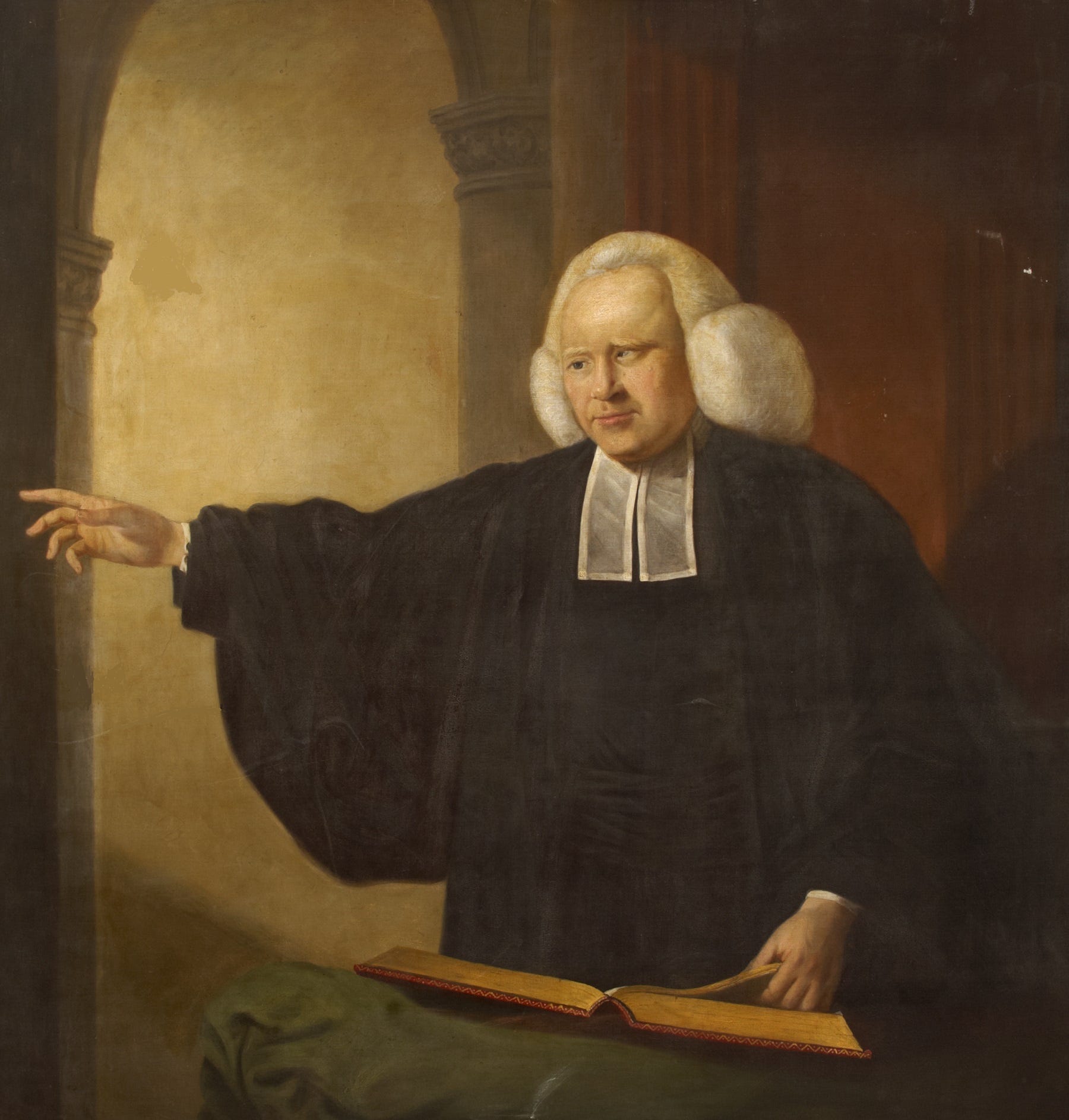
He and George Whitefield worked closely together in their early years along with John’s younger brother Charles. Whitefield was younger than the Wesleys and deferred to them in the early years. But it was Whitefield’s evangelistic fervor which sparked the Great Awakening. In 1739 he began preaching outdoors, taking the gospel from sophisticated England to the streets of London and the fields of America. The Wesleys followed his passionate example. As men and women came to Christ, he relied on John Wesley to disciple them.
But things weren’t to continue so peaceably. Whitefield was sympathetic to Puritanism, which had inherited Calvinist doctrines. He was also influenced by Jonathan Edwards, the American Puritan. Whitefield and Wesley disagreed on the nature of election and on the extent of Christ’s atonement. Wesley rejected divine election and held to universal atonement; Whitefield accepted divine election and held to a particular atonement. The disagreement existed between them privately, but it exploded in public controversy when Wesley preached a sermon “Free Grace” in which he attacked Whitefield’s Calvinistic views. The effect was exacerbated because Wesley preached the sermon immediately after Whitefield sailed to America to evangelize. After over a year of private correspondence, Whitefield published a polemical letter against Wesley, countering arguments made in his sermon.
The tension simmered, boiled, and eventually scalded their relationship. Upon his return to England, Whitefield separated from Wesley and led a group of Calvinist Methodists. Wesley maintained his influence over the mass of Methodism, and most Methodists adopted his Arminian views, which eventually led to the liberalization of Methodism. As often happens, their personal disagreement about not-insubstantial theological issues, spread to their followers who conflicted far more than their leaders did.
Reconciliation in Christ
In 1742, three years after Wesley preached his sermon, things started to calm. As a moderate Calvinist, Whitefield didn’t let the doctrine of predestination hinder him from offering grace to all, or from insisting on the need for holiness in believers. John Wesley allowed (for a time) some souls might be elected to eternal life. When not overheated, both men saw such issues as non-essentials.
Ultimately, they were able to work cordially together, though the breach was never fully mended. Whitefield ceased his leadership of the Calvinist Methodist societies, no longer competing with the Wesleys to lead the Methodists. Whitefield later described Charles Wesley as ‘my very dear old friend’ and John as an ‘honored brother.’” When Whitefield passed away, he requested John Wesley preach his funeral. Wesley accepted and preached memorial services for Whitefield throughout England.
Arminianism in the 18th and 19th centuries was mostly shaped by John Wesley. After Wesley’s death, most of the leading Arminian theologians were his followers. The entire Methodist movement and its offshoots (e.g. the multiform Holiness movement) adopted Wesley’s version of Arminian theology.
Arminianism ebbed and flowed through the 19th century and into the 20th. Popular conceptions of Arminianism changed in the 20th century when Charles Finney, a self-identified Arminian, developed and preached a modified Arminianism. Maybe we’ll look at that some day.
Heresy?
At the root of these controversies was whether Arminianism might be a heresy, an evaluation that relies on presuppositions. Calvinists may view Arminianism as a serious error (heresy) due to its emphasis on human free will and conditional salvation, but it isn’t generally considered heresy within mainstream evangelicalism, as it affirms core doctrines like the Trinity, the deity of Christ, and salvation by grace.
Still proponents of Reformed theology, particularly following the Synod of Dordt, argue Arminianism is a “subtle heresy” because modern adherents teaches grace is resistible and salvation can be lost, which the Reformed believe shifts the focus from God’s sovereignty to human merit.
Many, including moderate Calvinists, argue it is a dangerous error rather than heresy, while others argue simply a valid alternative interpretation of scripture regarding free will. It is widely viewed as a legitimate, albeit different, tradition within Protestantism.
Arminianism emphasizes conditional election, universal atonement, and the potential for apostasy, whereas Calvinism emphasizes unconditional election and the perseverance of the saints.
Ultimately, while some Reformed theologians deem it a “damnable heresy,” others Calvinists classify it as a significant theological error rather than a complete denial of the gospel.
During a recent Sunday School lesson, my Baptist church’s pastor and one of the deacons discussed their views on it and came to the conclusion that one of them is a modified Arminian and the other is a modified Calvinist. They both take four of the five doctrinal points each tradition advances but they don’t agree on which of the four they accept. And they both attend the same church and consider each other brother’s in the Lord. The deacon fills in at the pulpit when our pastor is out, so obviously neither the pastor or the congregation cares overmuch about the disagreement.
In my home town of Delanco, N.J. we have a Presberitan and a Methodist Church, which had revivalistic summer camps in the S. Jersey area. The Presberterian were the gospel of prosperity was piety.