Seven Years War
The Big Picture

This series is on the foundations and Founding Fathers of the United States. Follow this link to the first article in the series.
The Seven Years’ War (1756 to 1763) was a global war fought by numerous great powers, primarily in Europe, with significant side campaigns in North America and the Indian subcontinent. Great Britain and Prussia allied against France and Austria, with other countries joining these coalitions. In the end, pretty much all of Europe was at war with each other.
The War of the Austrian Succession ended with the Treaty of Aix-la-Chapelle (1748), the terms of which satisfied no one. It was generally viewed as a temporary armistice. It led to a strategic realignment known as the Diplomatic Revolution, ending the long-running rivalry between Austria and France when the two declared war on Britain after signing the Treaty of Versailles in 1756, with a second agreement in 1757 bringing Prussia into the war on the side of Britain.
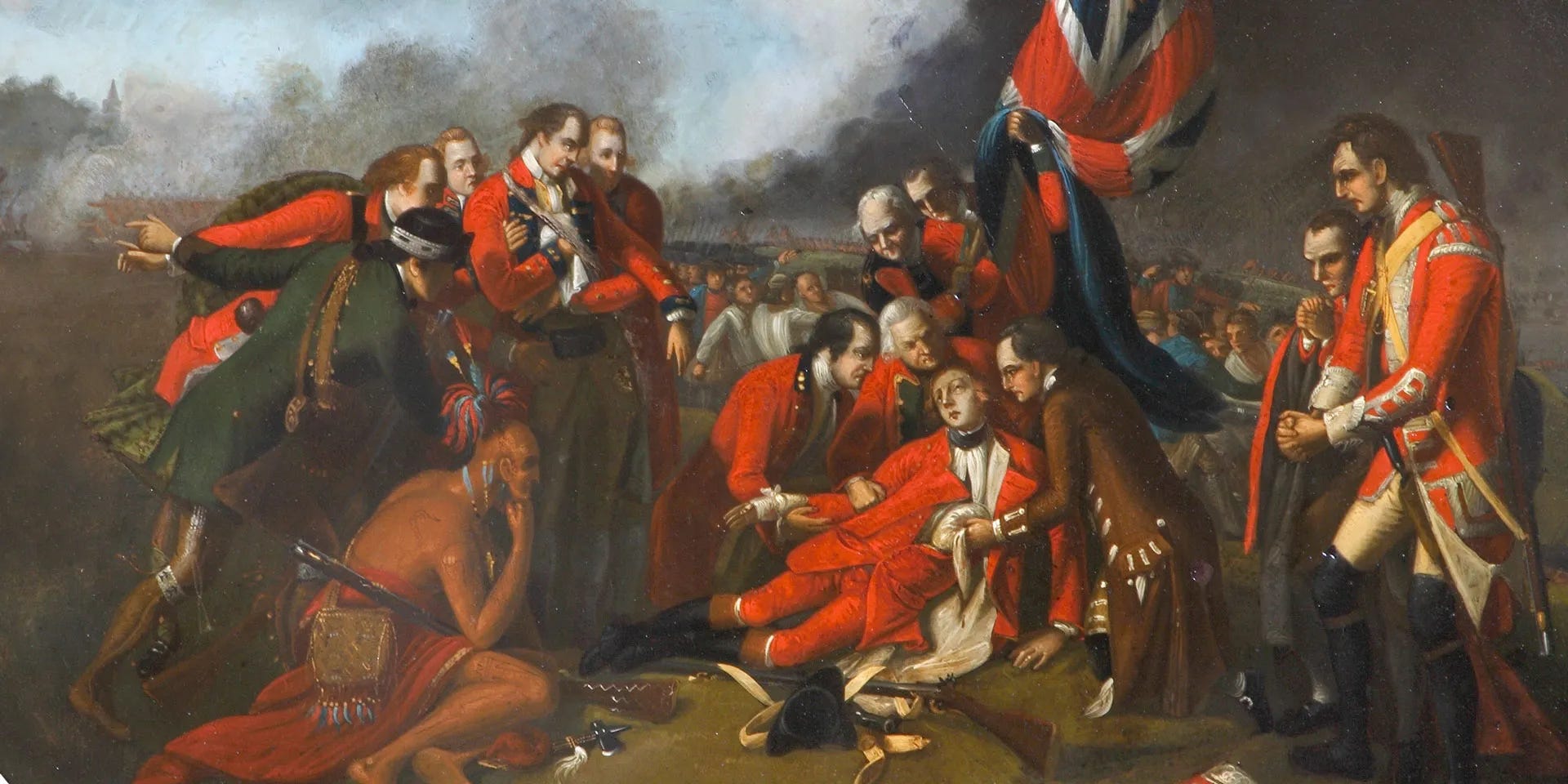
Spain became a French ally in 1762, unsuccessfully invading Portugal, and losing Havana and Manila to Britain. Although these were returned under the Treaty of Paris in 1763, France lost its possessions in North America, while Britain established its commercial dominance in India.
The conflict in Europe centered on Austrian attempts to recover Silesia, and ended with the Treaty of Hubertusburg in 1763. This confirmed Prussian occupation of Silesia and its status as a great power, challenging Austria for dominance in German-speaking regions, altering the European balance of power.
Opening Salvo
The first battle of the Seven Years War occurred in North America. The boundary between British and French possessions in North America was largely undefined in the 1750s. France had long claimed the entire Mississippi River basin, which the British disputed. In the early 1750s the French began constructing a chain of forts in the Ohio River Valley to assert their claim and shield their Indian allies from increasing British influence.
The British settlers along the coast were upset French troops would now be close to the western borders of their colonies. They rightly felt the French would encourage their tribal allies to attack them, and frankly, they wanted access to the fertile land of the Ohio River Valley for the new settlers flooding into the British colonies seeking farmland.
The most important French fort planned was intended to occupy a position at “the Forks”, where the Allegheny and Monongahela rivers meet to form the Ohio River in present-day Pittsburgh, Pennsylvania. Peaceful British attempts to halt this fort construction were unsuccessful, and the French proceeded to build the fort they named Fort Duquesne. British colonial militia from Virginia accompanied by Chief Tanacharison and a small number of Mingo warriors were sent to drive them out. Led by George Washington, they ambushed a small French force at Jumonville Glen in May 1754, killing 10, including commander Joseph Coulon de Jumonville. The French retaliated by attacking Washington’s force at Fort Necessity in July 1754, forcing Washington to surrender. Although the young Washington’s behavior exascerbated the local situation, leading to the first engagements of what would become the worldwide Seven Years’ War, truthfully England and France were already headed to war.
The British would later claim they were owed tax for “defending” the colonies, but the colonies had already fought several wars in support of England as a result of the English inability to seek peace with the French.
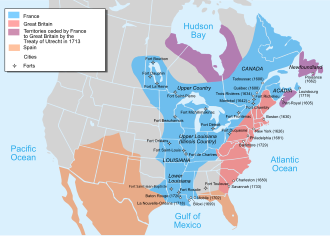
It could be argued the Seven Years War didn’t start with Washington’s foolishness at all. Britain and France didn’t negotiate a solution after receiving news about the clash. The two countries instead sent regular troops to North America to enforce their claims. The first British action was the assault on Acadia in June 1755, a full year later, in the Battle of Fort Beauséjour, which was immediately followed by their expulsion of the Acadians (who would migrate to present-day Louisiana to become the Cajuns). In July, British Major General Edward Braddock led about 2,000 regular army troops and provincial militia on an expedition to retake Fort Duquesne, but the expedition ended in disastrous defeat. In further action, Admiral Edward Boscawen fired on the French ship Alcide in June 1755, capturing it and two troop ships. In September 1755, British colonial and French troops met in the inconclusive Battle of Lake George.
The British navy harassed French shipping in 1755, seizing hundreds of ships and capturing thousands of merchant seamen even though the two nations were nominally at peace. Incensed, France prepared to attack Prussia, whose prince-elector was also the King of Great Britain and Minorca. Britain concluded a treaty with Prussia in which the latter agreed to protect Hanover. In response France concluded an alliance with its long-time enemy Austria, an event known as the Diplomatic Revolution.
European Theater
The War of the Austrian Succession had seen the belligerents aligned along traditional lines. Great Britain and Austria coalesced against Louis XIV, who supported Prussia, the leading anti-Austrian state in German-speaking regions. British subsidies to Austria didn’t really help England while the British military effort hadn’t saved Silesia for Austria. Prussia, having secured Silesia, came to terms with Austria in disregard of French interests. The France reluctantly concluded a defensive alliance with Prussia in 1747, and the Duke of Newcastle deemed the maintenance of the Anglo-Austrian alignment essential. But it shifted the balance of power in Europe and led to further war.
In 1756 Austria made military preparations for war with Prussia while pursuing an alliance with Russia. Vienna and Saint Petersburg agreed to a secret clause promising the restoration of Silesia and part of Poland to Austria in the event of hostilities with Prussia.
The Hanoverian King George II of Great Britain zealously guarded his family’s continental holdings, but his commitments in Germany were counterbalanced by the demands of the British colonies overseas. If war against France for colonial expansion were to resume, then Hanover had to be secured against Franco-Prussian attack. France was very much interested in colonial expansion and was willing to exploit the vulnerability of Hanover in war against Great Britain, but it had no desire to divert forces to Central Europe for Prussia’s interest.
French policy was complicated by the existence of a system of private diplomacy conducted by King Louis XV. Unbeknownst to his foreign minister, Louis established a network of agents throughout Europe with the goal of pursuing personal political objectives often at odds with France’s publicly stated policies. Louis’s goals included the Polish crown for his kinsman Louis François de Bourbon, Prince of Conti, and the maintenance of Poland, Sweden, and the Ottoman Empire as French allies in opposition to Russian and Austrian interests.
The results were absolute chaos.
Empress Elizabeth of Russia expressed outrage at British duplicity. The French were enraged and terrified by the sudden betrayal by its only ally, Prussia. Austria used this situation to their utmost advantage. Now-isolated France was forced to accede to the Austro-Russian alliance or face ruin. Thereafter, on May 1, 1756, France and Austria signed the First Treaty of Versailles, in which both nations pledged 24,000 troops to defend each other in the case of an attack. This diplomatic revolution proved to be an important cause of the war; although both treaties were ostensibly defensive in nature, the actions of both coalitions made the war virtually inevitable.
European warfare in the early modern period involved the widespread adoption of firearms in combination with more traditional bladed weapons. Eighteenth-century European armies formed around units of massed infantry armed with smoothbore flintlock muskets and bayonets. Cavalrymen were equipped with sabres and pistols or carbines. Light cavalry were used principally for reconnaissance, screening and tactical communications, while heavy cavalry were used as tactical reserves and deployed for shock attacks. Smoothbore artillery provided fire support and played the leading role in siege warfare. Strategic warfare in this period centred around control of key fortifications positioned to command the surrounding regions and roads, with lengthy sieges a common feature of armed conflict. Decisive field battles were relatively rare.
The Seven Years’ War, like most European wars of the 18th century, was fought as a so-called “cabinet war” in which disciplined regular armies were equipped and supplied by the state to conduct warfare on behalf of the sovereign’s interests. Occupied enemy territories were regularly taxed and extorted for funds, but large-scale atrocities against civilian populations were rare compared with conflicts in the previous century. Military logistics proved the decisive factor in many wars, as armies had grown too large to support themselves on prolonged campaigns by foraging and plunder alone. Military supplies, stored in centralized magazines, were distributed by baggage trains highly vulnerable to enemy raids. Armies were generally unable to sustain combat operations during winter and normally established winter quarters in the cold season, resuming their campaigns with the return of spring.
Strategy
For much of the 18th century, France standardized its approachto its wars, letting colonies defend themselves or offering only minimal help (sending them limited numbers of troops or inexperienced soldiers), anticipating fights for the colonies would most likely be lost anyway. This strategy was to a degree forced upon France by geography, coupled with the superiority of the British navy. The French navy just couldn’t provide significant supplies and support to overseas colonies. Similarly, several long land borders made an effective domestic army imperative for any French ruler. Given these military necessities, the French government based its strategy overwhelmingly on its army in Europe, hoping for victories closer to home. The plan was to fight to the end of hostilities and then, in treaty negotiations, to trade territorial acquisitions in Europe to regain lost overseas possessions.
This approach didn’t serve France well in Seven Years War. They lost their colonies. Although much of the European war went well, France had few counterbalancing European successes.
The British took a more practical approach to war. By avoiding large-scale commitments of troops on the continent, they sought to offset the disadvantage of this in Europe by allying themselves with one or more continental powers whose interests were antithetical to those of their enemies, particularly France.
The enemy of my enemy is, temporarily, my friend.
By subsidizing the armies of continental allies, Britain could turn London’s enormous financial power to military advantage.
In the Seven Years’ War, the British chose as their principal partner the most brilliant general of the day, Frederick the Great of Prussia, then the rising power in central Europe, and paid Frederick substantial subsidies for his campaigns. In marked contrast to France, Britain strove to prosecute the war actively overseas, taking full advantage of its naval power, creating naval blockades and also bombarding enemy ports, all facilitated by rapid troop movement by sea. They harassed enemy shipping and attacked enemy colonies, frequently using colonists from nearby British colonies in the effort.
The Russians and the Austrians were determined to reduce the power of Prussia, the new threat on their doorstep, and Austria was anxious to regain Silesia, lost to Prussia in the War of the Austrian Succession. Along with France, Russia and Austria agreed in 1756 to mutual defence and an attack by Austria and Russia on Prussia, subsidized by France.
Other continents
France and Britain were the main combatants in the colonial conflicts in India, North America, Europe, the West Indies, the Philippines, and coastal Africa. Over the course of the war, Great Britain gained enormous areas of land and influence at the expense of the French and the Spanish empires.
Great Britain lost Menorca in the Mediterranean to the French in 1756 but captured Fort Saint Louis, the centre of the French colonies in Senegal, in 1758. More importantly, the British defeated the French in its defence of New France in 1759, with the fall of Quebec. The buffer French North America provided to New Spain, the Spanish Empire’s most important overseas holding, was lost. The British Royal Navy took the French Caribbean sugar colonies of Guadeloupe in 1759 and Martinique in 1762 as well as the Spanish Empire’s main port in the West Indies, Havana in Cuba, and its main Asian port of Manila in the Philippines. British attempts at expansion into the hinterlands of Cuba and the Philippines met with stiff resistance. In the Philippines, the British were confined to Manila until their agreed upon withdrawal at the war’s end.
In South America, the Portuguese conquered most of the Rio Negro valley, and repelled a Spanish attack on Mato Grosso.
Between September 1762 and April 1763, Spanish forces led by don Pedro Antonio de Cevallos, Governor of Buenos Aires undertook a campaign against the Portuguese in the Banda Oriental, now Uruguay and south Brazil. The Spanish conquered the Portuguese settlement of Colonia do Sacramento and Rio Grande de São Pedro and forced the Portuguese to surrender and retreat.
Under the Treaty of Paris, Spain had to return Colonia do Sacramento to Portugal, while the vast and rich territory of the so-called “Continent of S. Peter” (the present-day Brazilian state of Rio Grande do Sul) would be retaken from the Spanish army during the undeclared Hispano-Portuguese war of 1763–1777.
As consequence of the war the Valdivian Fort System, a Spanish defensive complex in southern Chile, was updated and reinforced from 1764 onwards. Other vulnerable localities of colonial Chile were also made ready for an eventual English attack. The war also contributed to a decision to improve communications between Buenos Aires and Lima resulting in the establishment of a series of mountain shelters in the high Andes called Casuchas del Rey.
In India, the outbreak of the Seven Years’ War in Europe renewed the long running conflict between the French and the British trading companies for influence on the subcontinent. The French allied themselves with the Mughal Empire to resist British expansion, but derived little benefit from this. The war began in Southern India but spread into Bengal, where British forces recaptured Calcutta from the Nawab Siraj ud-Daulah, a French ally, and ousted him from his throne at the Battle of Plassey in 1757. In the same year, the British also captured Chandernagar, the French settlement in Bengal.
In the south, although the French captured Cuddalore, their siege of Madras failed, while the British commander Sir Eyre Coote decisively defeated the Comte de Lally at the Battle of Wandiwash in 1760 and overran the French territory of the Northern Circars. The French capital in India, Pondicherry, fell to the British in 1761 (it was returned after the war); together with the fall of the lesser French settlements of Karikal and Mahé this effectively eliminated French power in India.
In 1758, at the urging of an American merchant, Thomas Cumming, Pitt dispatched an expedition to take the French settlement at Saint-Louis, Senegal. The British captured Senegal with ease in May 1758 and brought home large amounts of captured goods. This success convinced Pitt to launch two further expeditions to take the island of Gorée and the French trading post on the Gambia. The battles in West Africa were ultimately a series of British expeditions against wealthy French colonies. The British and French had been competing for influence in the Gambia region following the acquisition of James Island in 1664 by the English from the Dutch. The loss of these valuable colonies to the British further weakened the French economy.
Despite being one of the major European powers during this time, the Ottoman Empire remained notably neutral during the Seven Years’ War. Following their military stalemate with the Russian Empire and their subsequent victory over the Holy Roman Empire (and Austria to an extent), during the Austro-Russian-Turkish War (1735–1739), and the signing of the Treaty of Belgrade, the Ottoman Empire enjoyed a generation of peace due to Austria and Russia contending with the rise of Prussia in Eastern Europe. Therefore, the Ottoman Empire avoided the major wars that followed, including the Seven Years’ War.
Persia ended up under the rule of the Zand dynasty during the period of the Seven Years’ War. Like the Ottoman Empire, they were also neutral during the war. They had more pressing matters to attend to. Karim Khan Zand was busy playing politics and was in the process of legitimising his claim to the Persian throne by placing a puppet king on the throne in 1757. However, by 1760, he had managed to eliminate all other potential claimants to the throne and established himself as the head of the Zand dynasty.
The Dutch Republic had played a central role in the Franco-Dutch War, Nine Years’ War and War of the Spanish Succession, which proved enormously costly. As a result, the Dutch sought to remain neutral in subsequent European conflicts, successfully during the War of the Polish Succession and unsuccessfully during War of the Austrian Succession. Pieter Steyn, the grand pensionary of Holland, led Dutch efforts to remain neutral in the run-up to the Seven Years’ War despite the Republic’s hostility towards France and alliance with Britain. The British government made an unsuccessful request for Dutch troops to be sent to Britain in 1756, and resistance from Amsterdam merchants to joining the war combined with French assurances that they wanted peace with Holland led Steyn to declare the Republic’s neutrality.
Despite diplomatic issues such as British seizures of Dutch merchantmen carrying what Britain defined as contraband, the Republic remained neutral for the duration of the war. Prussia viewed friendly relations with the Dutch as allowing them to secure their scattered possessions along the Republic’s eastern border, while Britain recognised that Holland’s seaports provided them with the most secure link to Hanover. The British government made plans to form a military-political bloc consisting of Britain, Hanover, Prussia and the Dutch Republic, but it didn’t materialize. To maintain good relations with Holland, the British eventually accepted the Republic’s neutrality and agreed to stop impeding Dutch trade.
Denmark–Norway also remained a neutral nation during the Seven Years War, although it could be argued it was a belligerent nation. It was very nearly dragged into the war on the side of France due to the actions of the Russian Empire. Tsar Peter III desired to reclaim his title of Duke of Holstein-Gottorp, whose lands were being overseen by the king of Denmark-Norway, Frederick V. Tsarina Catherine II, Peter’s wife, deposed before war broke out, thus saving Demark-Norway.
Outcomes
After what could be entitled the first World War, the Anglo-French hostilities ended in 1763 with the Treaty of Paris, which involved a complex series of land exchanges, the most important being France’s cession of Louisiana to Spain and the rest of New France to Great Britain. Britain returned the islands of Saint Pierre and Miquelon to France, which had been ceded to Britain in 1714 under the Treaty of Utrecht. Faced with the choice of regaining either New France or its Caribbean Island colonies of Guadeloupe and Martinique, France chose the islands to retain these lucrative sources of sugar, writing off New France as an unproductive, costly territory. France also returned Minorca to the British. Spain lost Florida to Great Britain, but received all of the former French holdings west of the Mississippi River. The exchanges suited the British since their own West Indian islands already supplied ample sugar. With the acquisition of New France and Florida, they now controlled all of North America east of the Mississippi.
In India, the British retained the Northern Circars, but returned all the French trading ports. The treat required the fortifications of these settlements be destroyed and never rebuilt, while only minimal garrisons could be maintained there, thus rendering them worthless as military bases. Combined with the loss of France’s ally in Bengal and the defection of Hyderabad to the British as a result of the war, this effectively brought French power in India to an end, making way for British hegemony and eventual control of the subcontinent.
France’s navy was crippled by the war, requiring working with Spain on an ambitious rebuilding program before France could challenge Britain’s command of the sea.
Austria wasn’t able to retake Silesia or make any significant territorial gain, but it did prevent Prussia from invading parts of Saxony. More significantly, its military performance proved far better than during the War of the Austrian Succession and seemed to vindicate Maria Theresa’s administrative and military reforms. Hence, Austria’s prestige was restored in great part and the empire secured its position as a major player in the European system.
Prussia emerged from the war as a great power whose importance could no longer be challenged. Frederick the Great’s personal reputation was enormously enhanced, as his debt to fortune (Russia’s betrayal after Elizabeth’s death) and to British financial support were soon forgotten, while the memory of his energy and his military genius was strenuously kept alive. Though depicted as a key moment in Prussia’s rise to greatness, the war actually weakened Prussia as its lands and population were devastated though Frederick’s extensive agrarian reforms and encouragement of immigration soon solved both these problems. Despite this truth, Prussia become one of the most imitated powers in Europe.
Russia made one great invisible gain from the war when it eliminated French influence in Poland. The First Partition of Poland (1772) was to be a Russo-Prussian transaction, with Austria only reluctantly involved and with France completely absent. Though the war ended in a draw, the performance of the Imperial Russian Army against Prussia improved Russia’s reputation as a factor in European politics, as Russian soldiers proved capable of going head-on against the Prussians, inflicting and taking one bloody volley after another, and though the quality of Russian generalship varied widely, the Russians were never decisively defeated in the war.
Despite its victories, Britain ended the war close to bankruptcy and now faced a difficult situation in North America after the war’s conclusion. It had to pacify both its new French-Canadian subjects and the many American Indian tribes that had previously supported France, all while its British colonial subjects suffered economic hardships brought on by the fighting.